

Data Quality
Data quality in AI measures how accurate, complete, consistent, timely, and representative data is across the AI lifecycle.
High-quality data enables reliable performance, trustworthy insights, and fair outcomes, while poor-quality data increases bias, reduces model effectiveness, and elevates operational, compliance, and business risk in AI-driven decision-making. This is why AI governance is no longer optional, it’s the foundation for turning trusted data into measurable business value.

Key Dimensions of Data Quality in AI
In AI, data quality is evaluated based on how well the data supports model training, evaluation, and real-world performance.
Key aspects include:
- Accuracy: Data correctly reflects real-world conditions that the model is expected to learn from
- Completeness: Important features or records are not missing, especially those affecting outcomes
- Consistency: Data remains uniform across sources, reducing conflicting signals during training
- Representativeness: Data reflects the diversity of real-world populations and scenarios
- Timeliness: Data is current and relevant to how the model will be used
- Label quality: Annotations or labels used in supervised learning are correct and unbiased
These dimensions determine whether an AI system can generalize effectively and produce reliable outputs in real-world conditions.
Why Data Quality Matters in AI Governance
The importance of data quality in AI models lies in how directly it affects system behavior. AI systems learn patterns from data, so any gaps, inconsistencies, or bias in that data can lead to unreliable or unfair outcomes.
In AI governance, data quality plays a critical role in ensuring that systems are reliable, fair, and aligned with regulatory and organizational expectations.
Strong data quality practices help organizations:
- Improve model accuracy and reliability
- Reduce bias and unfair outcomes
- Support explainability and consistent system behavior
- Strengthen auditability and documentation
- Meet regulatory and governance requirements
- Build trust among users, stakeholders, and regulators
Data quality is closely connected to governance processes such as AI risk management and AI impact assessments. These processes rely on high-quality data to evaluate risk and real-world impact accurately.
How Data Quality is Managed in AI Systems
Managing data quality in AI requires continuous oversight across the system lifecycle.
Organizations typically:
- Define data requirements based on the AI system’s use case
- Validate and clean datasets before training
- Assess representativeness to reduce bias and gaps
- Monitor data and model performance for drift over time
- Establish governance processes for data ownership and accountability
- Document data sources, transformations, and limitations
These practices reflect common best practices for data quality in AI, helping organizations maintain reliability as systems evolve.
Tools and Frameworks Supporting Data Quality in AI
Several standards and frameworks help organizations evaluate and manage data quality in AI systems.
- NIST AI RMF - Helps organizations identify and manage AI risks, including risks related to data quality and reliability.
- ISO/IEC 25012 - Defines key data quality characteristics such as accuracy, completeness, and consistency.
- EU AI Act (Article 10) - Sets data governance and data quality expectations for high-risk AI systems.
- Credo AI Platform - Helps organizations assess and monitor data quality within broader AI governance workflows.
These frameworks support structured, consistent approaches to maintaining data quality across AI systems.
Risks of Poor Data Quality in AI
Poor data quality can significantly affect how AI systems perform and the outcomes they produce. Because models rely on data to learn patterns, any issues in the data can directly translate into unreliable or harmful results.
Common risks include:
- Unreliable predictions - Inaccurate or incomplete data can lead to incorrect outputs and weak decision-making
- Biased or unfair outcomes - This highlights the role data quality plays in AI bias, as poor or unrepresentative data can amplify discrimination
- Performance issues in deployment - Models trained on poor-quality data may fail to generalize in real-world environments
- Limited explainability - Inconsistent or low-quality data can make it harder to understand and justify model behavior
- Increased compliance and audit risk - Poor data quality can lead to gaps in documentation, traceability, and regulatory alignment
- Loss of trust - Unreliable AI outputs can reduce confidence among users, stakeholders, and regulators
Addressing data quality early helps reduce these risks and supports more reliable and responsible AI systems.
Data Quality vs. Data Governance in AI
Data quality and data governance are closely related, but they do not mean the same thing.
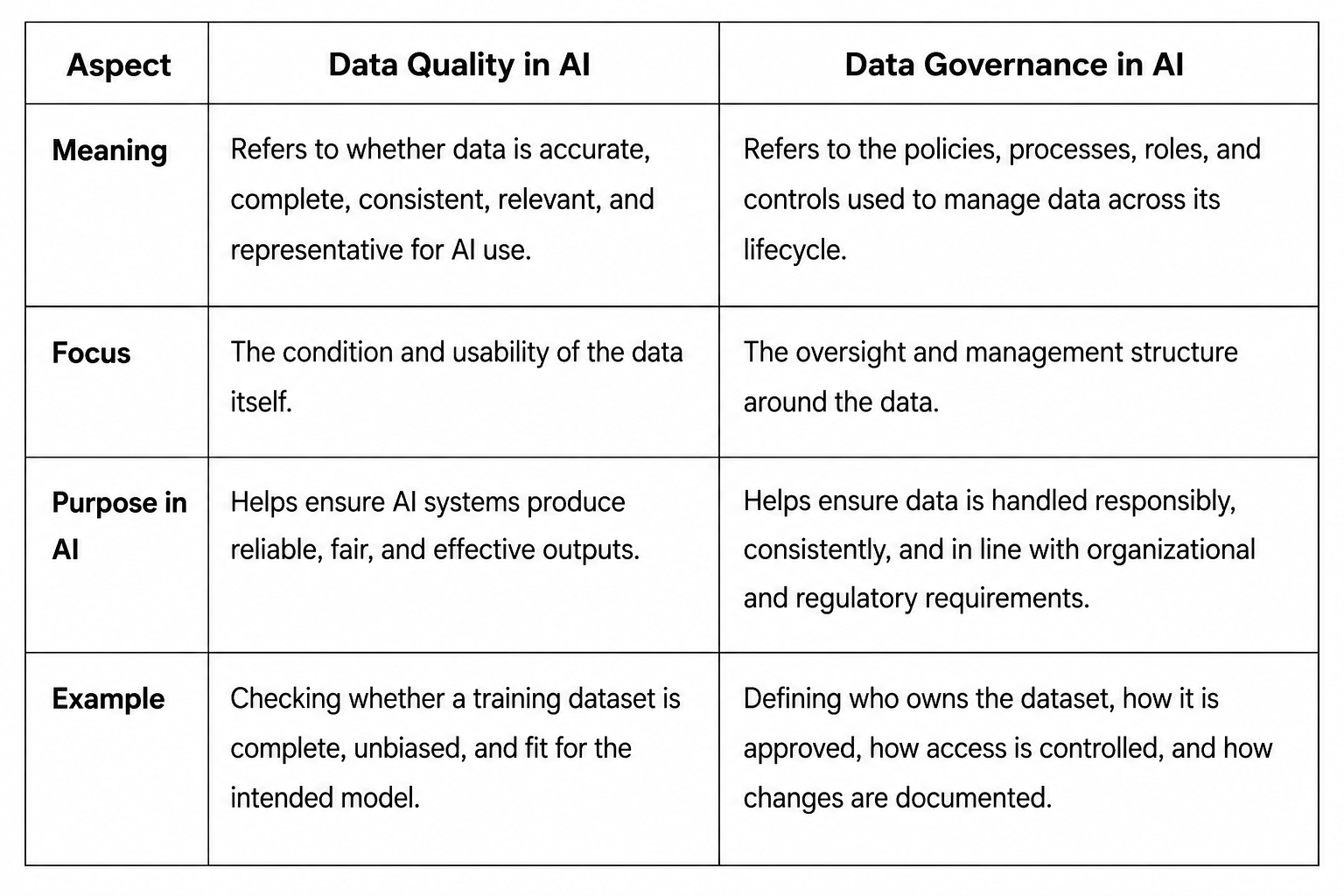
In AI, data governance provides the structure needed to maintain data quality over time. Together, they help support reliable, accountable, and trustworthy AI systems.
Summary
Data quality is essential for building reliable, fair, and effective AI systems. By ensuring data is accurate, complete, and consistent, organizations can improve model performance, reduce risk, and support responsible AI practices. As AI adoption grows, maintaining high data quality becomes a critical part of trustworthy and compliant AI governance.
Frequently Asked Questions
Here you can find the most common questions.
How is data quality different in AI compared to traditional systems?
In AI, data quality directly affects how models learn and behave. Unlike traditional systems, poor-quality data can change model predictions, introduce bias, and impact real-world decisions.
Why is representativeness important in AI data quality?
If data does not reflect real-world populations or scenarios, AI systems may perform poorly or unfairly for certain groups.
Does improving data quality always improve AI performance?
In most cases, better data quality leads to more reliable and accurate models. However, improvements must align with the model’s intended use and context.
What are the top use cases for AI in data quality?
Some of the top use cases for AI in data quality include anomaly detection, missing-value identification, deduplication, error detection, and pattern analysis across large datasets.