We are living through a transformational moment. AI has stopped merely answering and has started acting. Agents read our repositories, touch systems of record, move money, ship code, and make calls that used to require a person in the loop. That is not just a risk to manage. It is the biggest opportunity most enterprises have had in a decade, and I am genuinely excited about it.
Opportunities of this magnitude come with a real question, though: the instant an agent can act on our behalf, what is it actually allowed to do? Not what AI do we have, but what can this agent do right now, with this data, using this tool, and who is accountable when it matters. That question is not going away. Answering it well is what lets enterprises move faster, not slower.
A model supplies capability. Only governance earns it the right to act.
From governing models to governing actions
Since we created the AI governance category six years ago, governing AI has mostly meant governing what it said: policies, evaluations, dashboards, review boards, risk-based assessments, and review gates. Those are still the right tools for AI applications, models, and vendors. They just do not work for agents. An agent acts, so governance has to apply the moment it acts, not in a report written afterward.
That is the shift from governing models to governing actions. We call the next expansion of AI governance Enterprise Agent Governance, and it has to reach the layer where agents actually run: the agent harness, the software that decides what an agent can touch, when, and under whose authority.
It also has to work for builders and governors at the same time. The builder needs to ship without waiting on a manual review. The governor needs to know, at any moment, exactly what an agent is allowed to do. Enterprise Agent Governance is the one set of controls that lets both happen: something the builder ships with by default, and the governor can verify directly, instead of two separate processes each side has to take on trust.
Scale is why this cannot be optional. The average large enterprise is expected to be running more than 150,000 agents by 2028, far more than its human employees. No enterprise governs 150,000 employees one conversation at a time; it relies on onboarding and a code of conduct that applies to everyone from day one. Agents, as a digital workforce, need the same thing: standardized governance that every agent inherits the moment it is deployed, not a policy written down and hoped for.
Runtime governance-as-code
This is not a new idea for us. For years, Credo AI's work has been turning policy into code: taking what an enterprise has decided about acceptable AI use and making it something a system checks automatically, instead of something a person has to remember to enforce.
Agents are why that work now has to go further. Governance-to-code, for us, means taking not just policy but the full context behind it, business intent, regulatory obligation, risk appetite, organizational judgment, and compiling all of it into code that runs inside the agent's own loop, at the exact moment it decides to act. We call the result decision governance: ensuring an agent's actions match the context and intent it was actually given, moment to moment, not just the intent someone assumed when it was built. Runtime enforcement that resolves, in real time, whether an agent's next move is allowed, blocked, escalated, or advised, and that leaves behind the evidence to prove it.
Runtime Governance-to-code
Business context + governance context → Policy → Code enforced at runtime in the agent's loop → Evidence → a better next policy & Governance posture
That is a genuinely hard problem. It is also, I think, a genuinely exciting one: an enterprise's hard-won judgment about what “acceptable” actually means can now travel with an agent everywhere it goes, instead of sitting in a document nobody reads.
Picture a coding agent asked to fix a security issue. It reads the repository, proposes a change, prepares to run a test. Governance-to-code is what lets that agent move freely right up until the moment it tries something destructive, and allows a human to step in only there, instead of everywhere. That is what acting with real authority looks like: not automation with the safety switched off, and not a person reviewing every keystroke, but a system that knows the difference and acts accordingly, at the speed the work actually happens.
Why this is worth being excited about
Most of the conversation about agents right now is about fear: what could break, leak, or go wrong. Those risks are real, and we take them seriously.
But what motivates us more is the other half of that question: what happens when we get agents right ? Enterprises that genuinely trust and control their agents do not just avoid incidents. They get to move faster, into higher-stakes work, with confidence instead of hesitation, because the guardrails are real instead of theoretical. Done well, trust is not a brake on how much of this technology an enterprise can use. It is what lets them use more of it, sooner.
That is our bet: agents are genuinely powerful, and trust is what lets an enterprise capture that power, instead of waiting on the sidelines for someone else to prove it is safe first.
Trust compounds
There is a compounding effect here that is easy to miss. The first agent an enterprise governs well takes real work: mapping intent, setting policy, deciding what evidence actually matters. The hundredth should not. It inherits the patterns, the controls, and the trust already earned by the ninety-nine before it.
That is also how autonomy should be earned, not assumed. An agent does not deserve more authority because the model underneath it tested well on a benchmark. It earns that authority by demonstrating, with evidence anyone can review, that it behaves the way it is supposed to inside the boundaries it has been given. Widen those boundaries as trust is earned, tighten them the moment it is not. That is a far better trade than choosing once, upfront, between full autonomy and permanent human review, and it is a much more exciting one.
The organizations that lead the agent era will not be the ones willing to accept the most uncontrolled autonomy. They will be the ones that can govern authority precisely, learn continuously, and earn the right to do more.
Introducing Credo AI Agent Governor
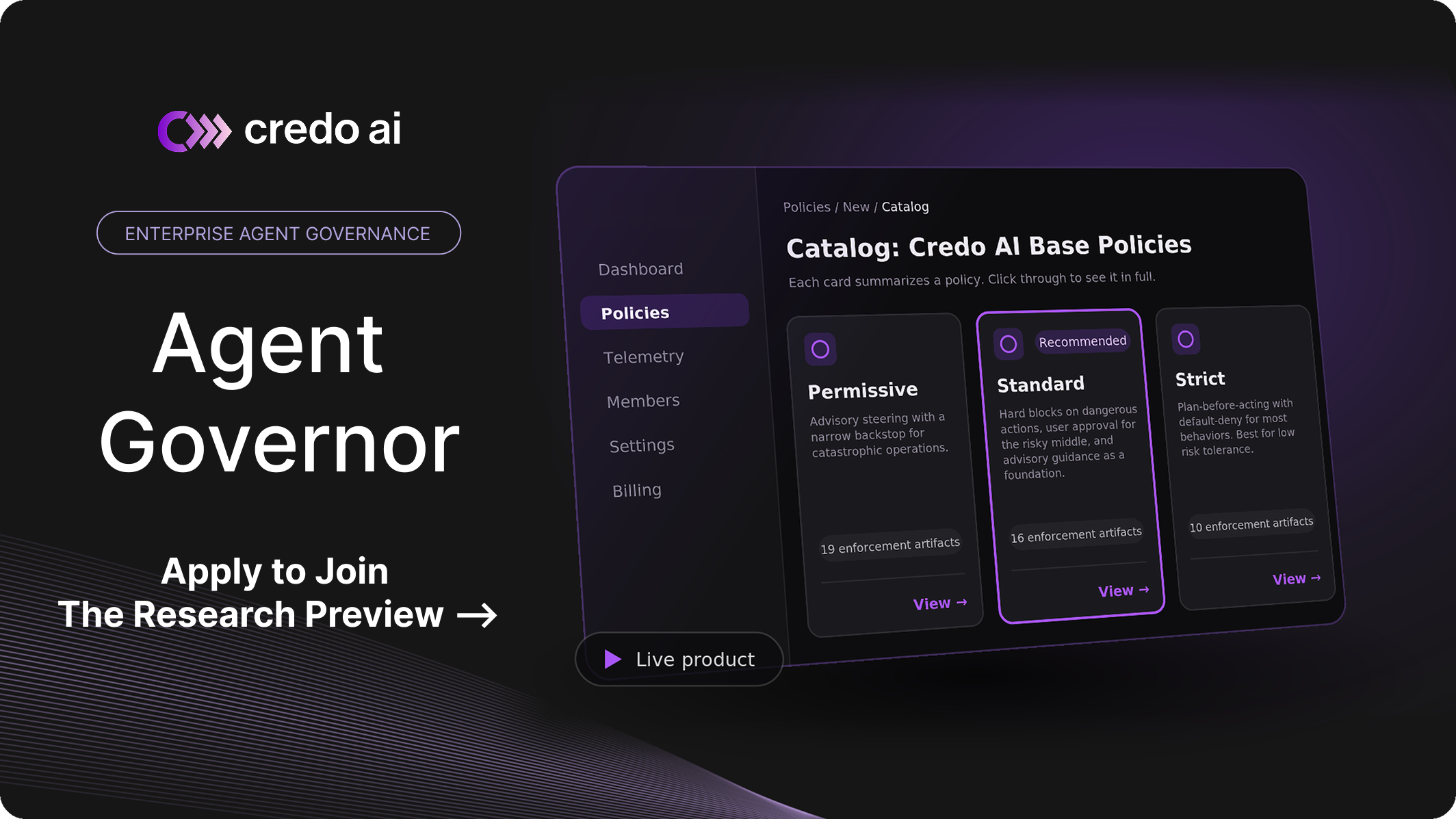
Agent Governor is where we are putting that conviction into practice. It is decision governance made real: our first product built on this thesis, and one we built with our own use in mind first. As we look to bring more agents into more of the real work inside Credo AI, we want to govern what they do as they do it, not review it after the fact.
We are starting by supporting governance of Claude’s harness, and will expand to other agent harnesses very soon. Beyond the harness layer, we are also looking ahead to governance at the gateway and the agent-platform layers, the other points where enterprises will need the same kind of oversight as agentic systems mature. Six years of building AI governance gave us the regulatory intelligence and the risk patterns; agents are teaching us the rest, in real time, and we would rather learn that alongside partners we trust than pretend we already have every answer. Our head of product, Ehrik Aldana, has written a companion piece with the specifics of how it works.
With Agent Governor now in Research Preview, we are looking for a small number of design partners who share this excitement about getting agentic AI right. If that sounds like you, we would love to have you. Join us and sign up here.
DISCLAIMER. The information we provide here is for informational purposes only and is not intended in any way to represent legal advice or a legal opinion that you can rely on. It is your sole responsibility to consult an attorney to resolve any legal issues related to this information.

.png)