The average Fortune 500 company is expected to run more than 150,000 AI agents by 2028, up from fewer than 15 in 2025. Nothing in how enterprises govern AI today can absorb that. In our own survey of 371 senior leaders, we found that 60 percent already deploy AI across multiple departments while only 4 percent govern it at scale.
The industry's answer has been more dashboards, more policy documents, more oversight committees. The diagnosis is right. The fix is aimed at the wrong layer.
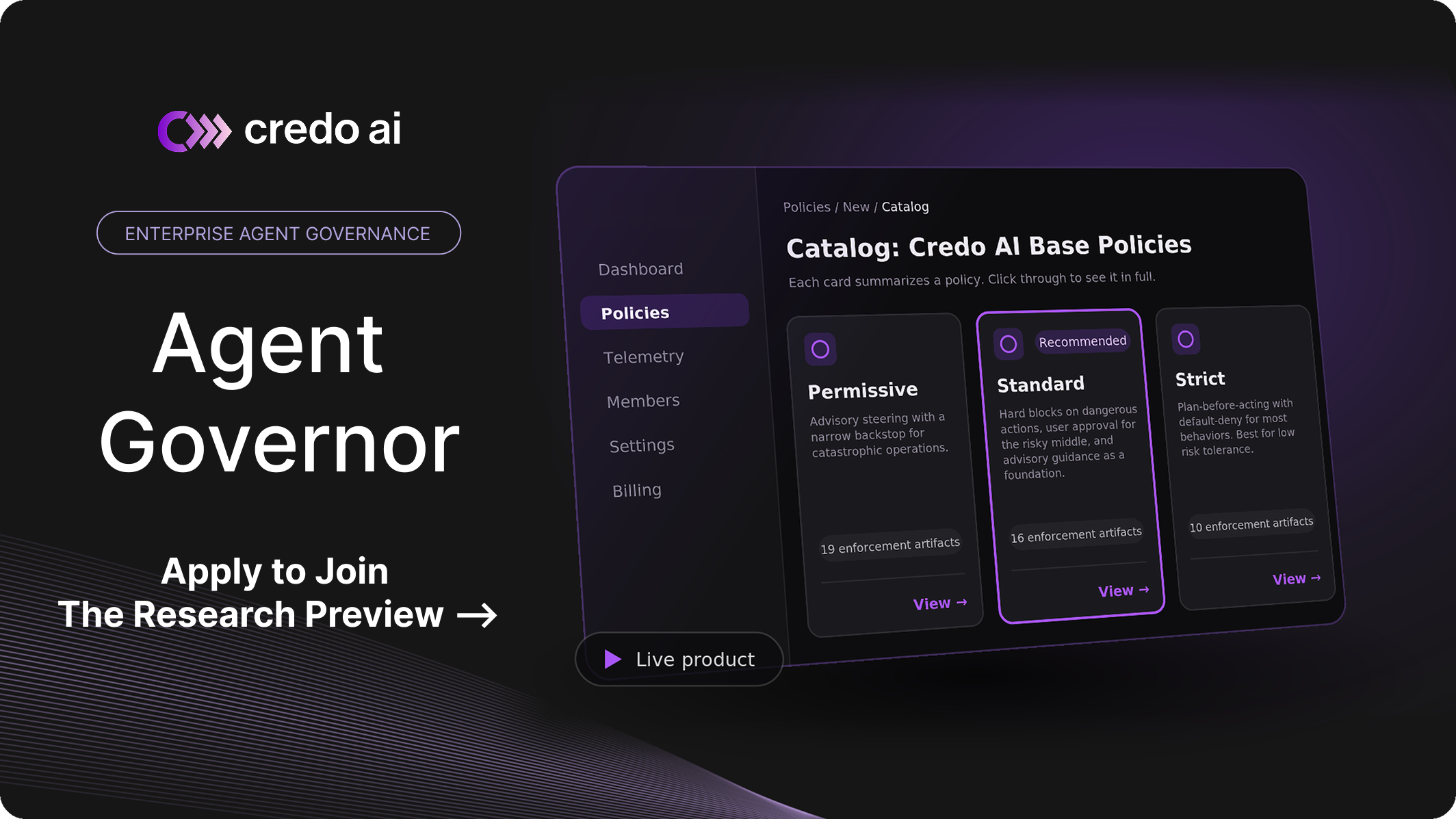
Today we're launching Credo AI Agent Governor in Research Preview. It governs agents at the layer where they actually act: the agent harness.
From models to outputs to actions
Enterprise AI governance has moved through three eras.
First, we governed models. What models do we have, who owns them, were they tested, do they meet our requirements? This was the world of inventories, model cards, and validation.
Then, generative AI made us govern outputs. Is the answer accurate, safe, on-policy? Bad outputs were never harmless: wrong guidance, leaked data, a biased decision. But an output only became an outcome when a person or a process acted on it, and that gap was where governance lived. You could evaluate, review, and correct between the answer and the business.
Now, agents act, and they act in volume. A single session can read a repository, call dozens of tools, write code, change records, and move work between systems. Each of those is an action landing directly on what the company runs on, with no draft passing through a reviewer first. No human can sit between hundreds of actions and their consequences, and no action can be governed after it happens. Governance has to be present the moment the agent acts.
The Agentic Trust Moment — our CEO Navrina Singh on why getting agentic AI right depends on governance-as-code at runtime.
The harness is where actions happen
A harness is the software that runs the agent. It decides which tools the agent can reach, which data it can see, and what happens in the instant before and after every action. Two agents on the same model behave completely differently in production depending on what their harnesses permit. That makes the harness the biggest lever on agent behavior that most enterprises have not yet pulled.
A prompt gives an agent an instruction. A harness determines how it acts. Harnesses are already everywhere. Claude Code, Codex, and Cursor are harnesses around coding models. Every homegrown agent built on an SDK runs inside a harness its developers assembled themselves. If an agent is in production, something is already deciding what it can touch. The question is whether that something reflects your organization’s policies, or the defaults of whoever built it.
What Agent Governor does today
Agent Governor is our answer. It's a new product that takes the governance your organization has already approved, installs it onto the agent harness as governance-as-code—versioned, enforceable controls the harness applies to the agent's actions as they happen—, and records the evidence. Risk and compliance define the rules, IT installs them, and builders keep working inside boundaries the organization approved.
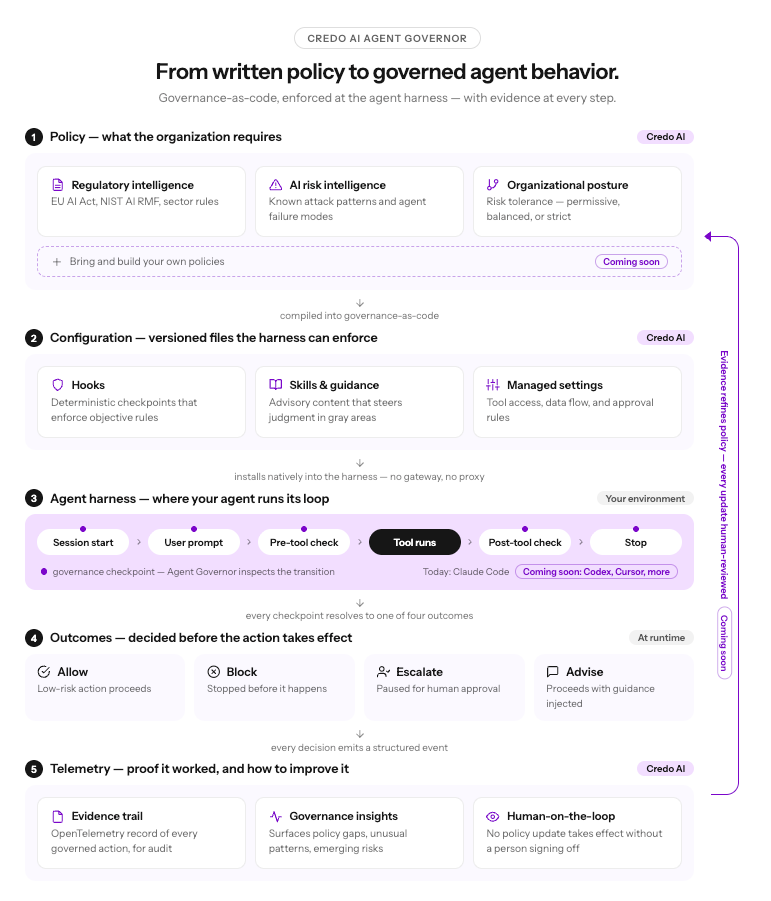
In Research Preview, we're starting with Claude Code and plan to expand to additional harnesses next. Coding agents are where the harness is most mature, and where ungoverned actions already cost real money: a bad commit, a leaked credential, a destructive shell command.
The product does four things:
- Gives risk teams a policy baseline. Agent Governor ships curated policies at three postures: permissive, balanced, and strict. They're grounded in six years of Credo AI’s AI governance intelligence, so risk teams start from a reviewed baseline, not a blank page.
- Installs easily locally or organization-wide. An IT admin picks a posture and installs it onto the harness, on a single machine or across the company. No hand-written configuration, no engineering ticket. A policy approved by risk on Monday can govern every Claude Code agent on Monday.
- Resolves every action to one of four outcomes. At each meaningful step in the agent's loop (session start, prompt, before and after every tool call, session end), the installed policy resolves to one of four outcomes: allow, block, escalate, or advise. A plain allow-or-deny binary either blocks too much or catches too little. The middle matters: some actions need a person's sign-off before they proceed, and some just need a warning the agent can take into account.
- Keeps a record as it works. Every decision produces a structured record: which policy version was active, who started the session, what tool was called with what arguments, what was decided and why.
Concretely, under the a configuration with the balanced posture applied, a Claude Code agent fixing a security bug can read the repository but not the credential store. Its tests run without interruption. A destructive shell command is blocked. A new dependency above the risk threshold stops and waits for a named human. A secure-coding suggestion arrives as advice, not a ticket. When the session ends, Agent Governor has a record of these governed actions.
Right-sized governance, faster adoption
The easy mental model for a harness is a checkpoint that waves actions through or stops them. Real organizations don't govern people that way. They use onboarding, a manager who catches bad calls in real time, an escalation path, and a review loop. The structure works because it's built into how the job happens.
A harness is the agent's version of that structure. Light touch on routine, reversible work. Tighter review as consequences grow. A hard boundary at direct writes to systems of record, where deterministic checks and a human keep final authority. Agents earn autonomy by demonstrating reliability inside those boundaries, not by benchmarking well.
That's also the roadmap. We're standardizing governance at the harness level first. From there we calibrate enforcement per use case, tighter or looser based on how deep the agent reaches into your systems and how trustworthy its inputs are.
Why now?
We built Agent Governor because we needed it. Over the past year, agents inside Credo AI went from experiments to real operating work: writing code, testing product changes, moving work between our systems. Reviewing what they did after the fact stopped being enough, and asking every team to invent its own controls would have slowed the adoption we wanted. So we took the governance posture we've developed over six years of building AI governance software and applied it to the action layer, building Agent Governor and running it in our own environment ever since.
It changed our own calculus. With controls and a record built into every session, we could say yes to more agents, on more consequential work, sooner, in a way that kept us safe and that our customers can trust. That is the position we want every enterprise to be in.
Research Preview is how we widen the circle: a small group of design partners who will shape how Agent Governor works in their environments, the way our own use already shaped it.
If you're building or governing agents in a regulated or high-consequence enterprise, we want you in that group.
Sign up today for a research preview of Credo AI Agent Governor.
We are excited to build the future of Enterprise Agent Governance with you!
DISCLAIMER. The information we provide here is for informational purposes only and is not intended in any way to represent legal advice or a legal opinion that you can rely on. It is your sole responsibility to consult an attorney to resolve any legal issues related to this information.

.png)