

Over the last few years, AI has become a competitive advantage for enterprises – those that fail to embed it across their operations risk being outpaced by those that do. Agentic AI has driven much of this shift. Where earlier systems handled discrete tasks, agents now run multi-step processes, pushing organizations to rethink established processes, roles and responsibilities.
But the potential of Agentic AI is hard to harness, and adoption alone no longer secures the lead. As AI grows more abundant, it also grows less visible. Accessible tools and broad-use mandates have put AI in everyone’s hands, but teams and departments are often building in isolation. Returns are slow to appear even as investment climbs: in a 2026 Gartner survey, only 28% of AI use cases in infrastructure and operations fully met ROI expectations, and 20% failed outright (Gartner, 2026). Since the costs and value of Agentic AI are difficult to predict at the outset, this can lead to wasted resources, stalled projects, and duplicated efforts.
The organizations that pull ahead will be those that treat AI as a managed portfolio rather than a set of experiments, with visibility into cost, value and risk.
Today, while 60% of organizations are deploying AI across multiple departments, only 4% are governing it at scale (Credo AI, State of AI Governance Report 2026).
Governance was traditionally seen as a control function, but in the agentic age its role is broader: it establishes the systems and processes that gives an organization a real-time view of where AI is being used, what it costs, and whether it is delivering. AI initiatives are treated as interconnected investments rather than isolated experiments, and that is where AI portfolio management begins.
Managing an AI portfolio in the Agentic Era
What gets measured is what gets managed. AI portfolio management means identifying, prioritizing, tracking and governing AI initiatives across an enterprise through a single, holistic lens, helping executives view and make data-driven decisions about AI projects.
It helps bring control and visibility into AI usage, empowering executives to view AI initiatives as a coordinated portfolio, as opposed to isolated deployments or untracked pilots.
It answers four central questions:
1. Where is AI being used?
2. What does it cost, and what measurable benefits or outcomes does it deliver?
3. How do these initiatives support the company’s broader strategic goals?
4. How do initiatives depend on and affect each other?
Done well, it enables the strategic and financial assessment of initiatives through an interconnected lens, helping enterprises achieve higher returns on AI investments.
It creates a shared accountability for AI programs between business and developer teams, helps identify redundant and duplicative initiatives, and ultimately establishes the foundation for sustained long-term business forecasting and planning.
Why Measuring Value is Hard
The value from AI is rarely easy to measure. Most times, it’s not readily visible. Gartner found that 69% of organizations already suspect or have evidence that employees are using unapproved public AI tools, beyond the reach of central oversight. (Gartner, 2025)
Other times, AI is introduced alongside other technology efforts, has long payback periods, or is tracked by metrics developed by siloed teams, which cannot be measured with precision across a portfolio.
Agentic AI complicates this, since its costs and value vary by usage. An agent’s costs compound based on its token consumption, frequency of reasoning loops, how often it invokes internal or external APIs, its handoffs to other agents, and its orchestration overhead costs. On the other hand, an agent’s value is shaped by the quality of the data and processes it operates within, its autonomous capabilities and limits, and the accuracy and consistency of its output.
Traditional portfolio management was not built for Agentic AI, since it assumes predictable projects with defined outcomes and fixed measures of cost and value. AI portfolios, particularly Agentic AI portfolios, must navigate a set of coordinated initiatives with non-deterministic outcomes and evolving capabilities.
To keep pace, portfolio management should be integrated with governance so that performance, return and risk are assessed holistically and revisited as initiatives evolve. Continuous oversight comes together with cost and value assessment across an AI initiative’s lifecycle.
How Governance Makes Value Measurable
The core challenge enterprises face is a lack of visibility into where AI is used, and no consistent way to track success metrics across initiatives. Without tracking, organizations cannot steer AI toward efficiency and business value.
This is where AI governance comes in – it establishes the processes that define how AI is used, who is accountable, and how AI value is monitored over time. Additionally, AI initiative’s risk posture feeds directly into these decisions, informing whether it is viable and worth the investment.
Strategy and resourcing set the direction for an AI portfolio, but governance is what carries it through in practice. It brings return and risk assessment into portfolio decisions at every stage of an initiative’s lifecycle:
- An AI registry captures each AI use case at intake
- Continuous monitoring tracks its cost and performance in production
- Regular reviews help decide which use cases to expand and which to retire
This keeps AI investments aligned with strategy and delivers coordinated value across the enterprise.
How governance comes together with portfolio management for the Enterprise
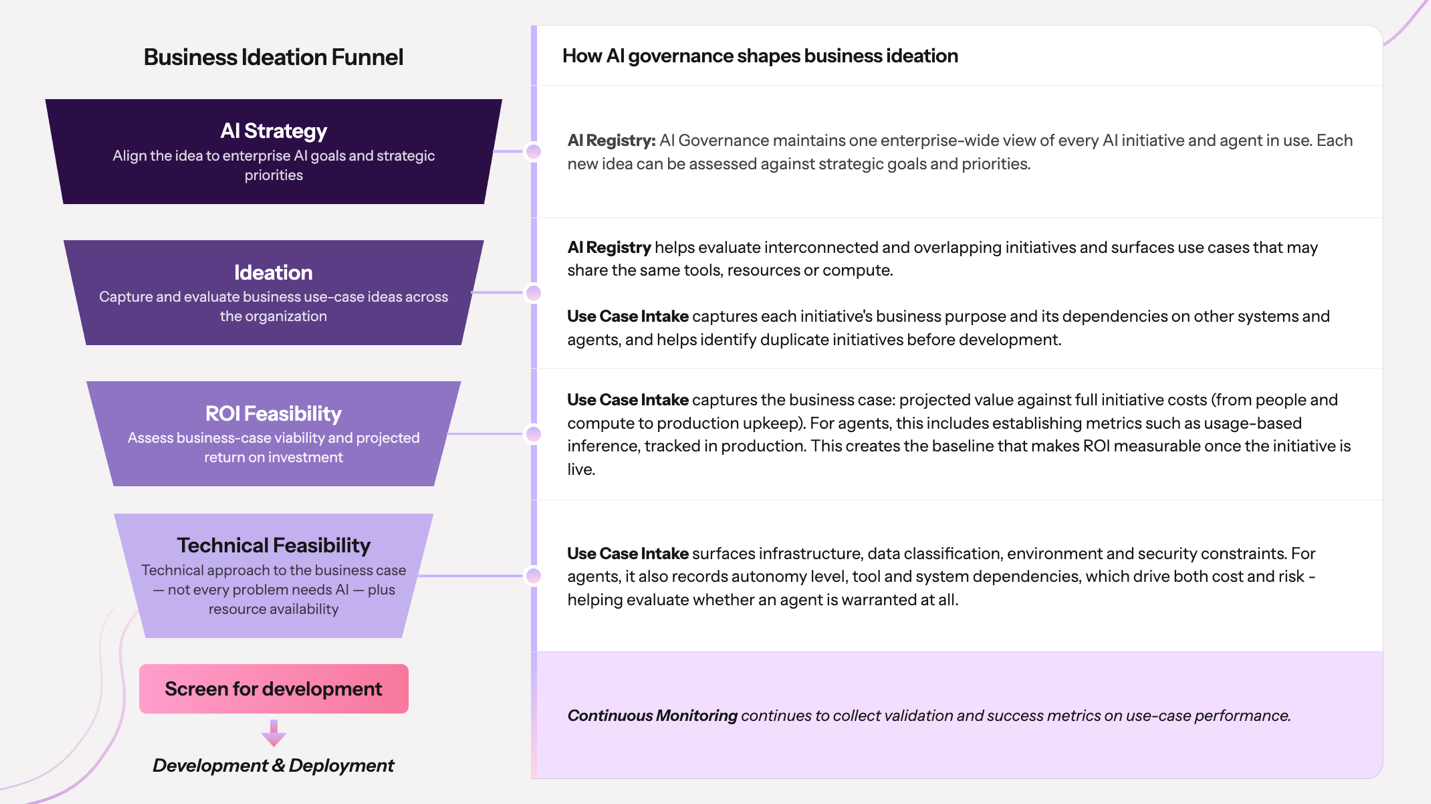
Setting the baseline: Ideation and Intake
Governance helps shape business ideation by enforcing processes and structure to capture information that’s relevant to understanding an AI use case along the entirety of its lifecycle.
An agent registry serves a dual purpose: it records every AI initiative to assess its risk posture, and also captures its business purpose, expected outcomes, projected value against upfront investment, dependencies and key constraints.
Tracking value in production: Continuous monitoring and management
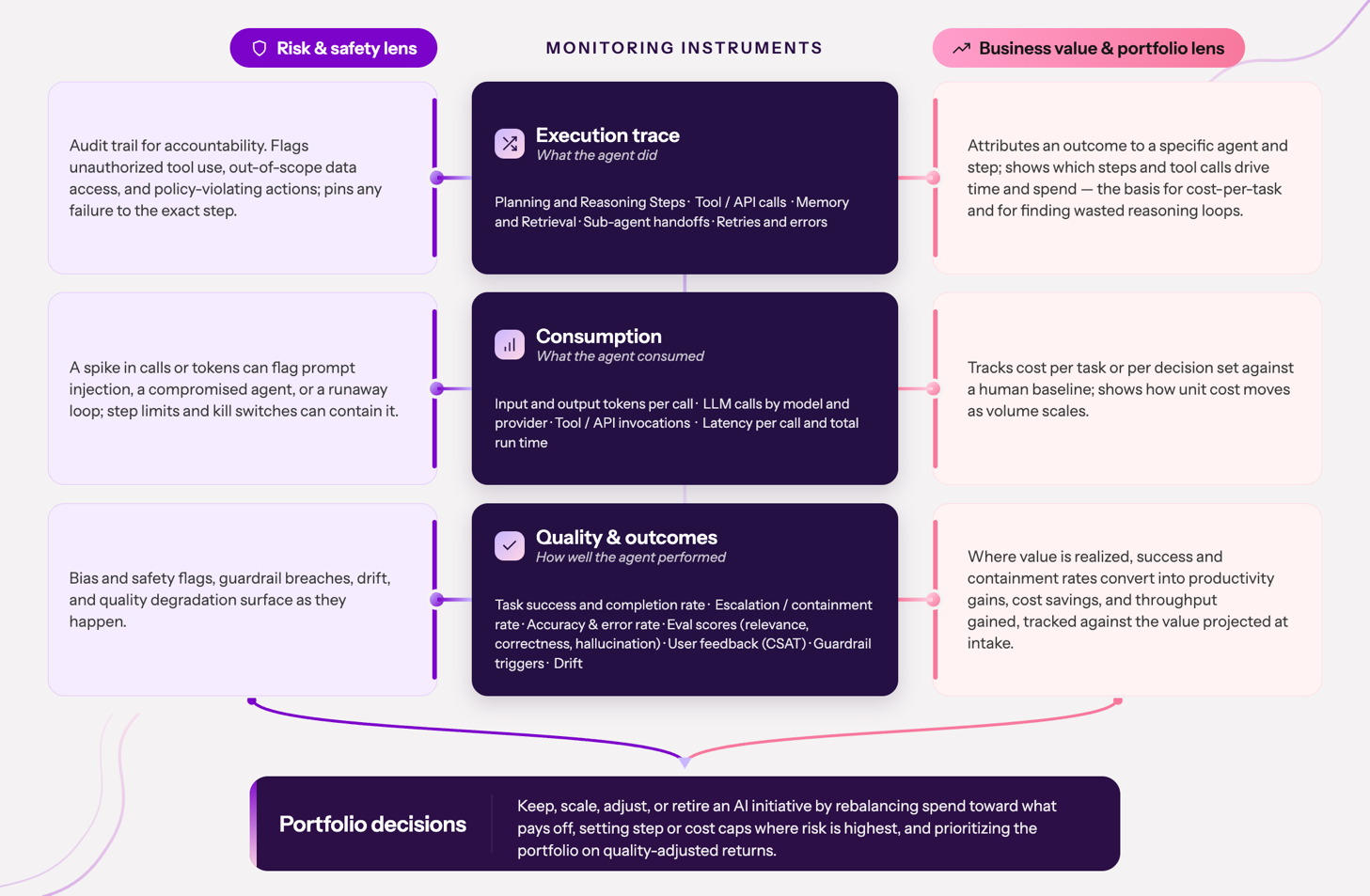
Enterprises have to continuously monitor, adjust and rebalance their AI portfolio as the technology evolves, business priorities shift, and early pilots yield new insights.
This is especially critical with agents, where the controls that keep agents safe are the same instruments that make their value measurable. Ongoing monitoring is typically framed as a core risk management activity, tracking things like model performance, bias and security incidents. But that same monitoring can be leveraged to surface metrics important from a business portfolio lens, including the consumption cost of AI in production, model and token usage, tool and API calls, task success and escalation rates.
For example, execution logging captures every step an agent takes: its tool and API calls, the data it accesses, and its handoffs. The same record serves as an audit trail for unauthorized or out-of-scope actions, and shows which steps and tools drive costs, helping identify cost anomalies and optimize usage in real-time.
These signals inform where to adjust investment, which initiatives to prioritize, and which may need cost caps. Continuous governance is what makes continuous portfolio management possible.
Deciding what to keep: Review and Retire
Governance also establishes a regular cadence for reviewing AI initiatives once they are in production.
Each review shows whether an initiative is still delivering its projected value, whether it remains aligned with business priorities, and whether its cost and risk are still justified. This lets leaders decide which initiatives to scale, which to hold, and which to retire, so the portfolio keeps directing investment toward the work that delivers the most value.
Agentic AI is reshaping how work gets done, but its value will not be captured by adoption alone. Ultimately, the winners will be the organizations that turn agentic AI into measurable business outcomes, not just widespread adoption. For leaders, this means having clear visibility into how AI is being used across the business and aligning it with strategic priorities. Governance turns agentic AI from a source of uncertainty into a measurable, defensible investment. Explore the Credo AI platform or talk to our advisory team to explore how you can put this into practice.
DISCLAIMER. The information we provide here is for informational purposes only and is not intended in any way to represent legal advice or a legal opinion that you can rely on. It is your sole responsibility to consult an attorney to resolve any legal issues related to this information.

.png)