

Programmatic RAI Assessments
Programmatic RAI assessments are automated tests that check whether AI systems meet responsible AI standards across fairness, performance, explainability, robustness, privacy, and compliance. They help organizations scale AI governance across teams, vendors, and regulations while creating measurable business value.
Learn how an AI governance framework reduces compliance risk, speeds deployment, and delivers measurable ROI.
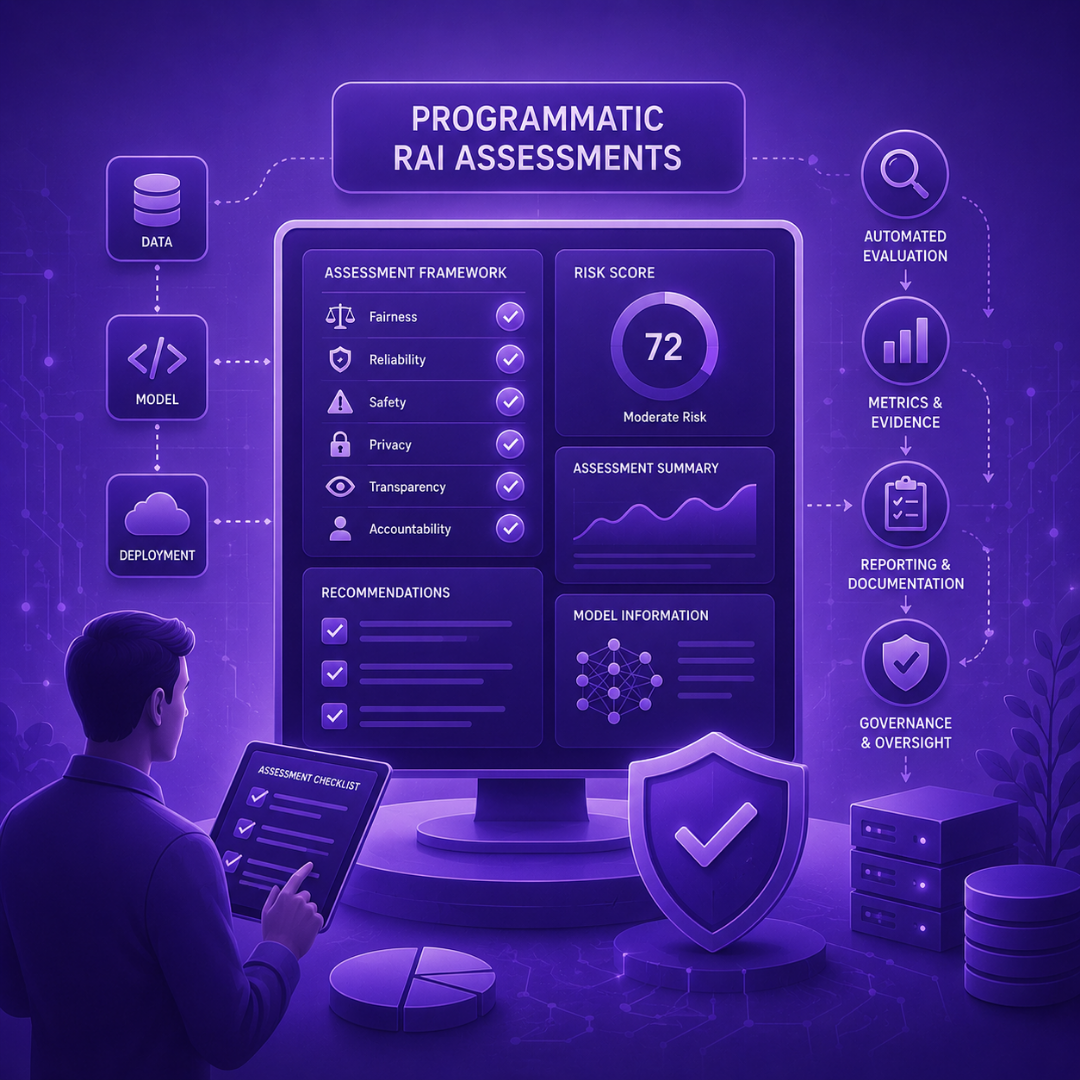
What Programmatic RAI Assessments Evaluate
Programmatic RAI assessments focus on measurable aspects of an AI system’s behavior, risks, and governance readiness.
Common evaluation areas include:
- Model performance: Measuring whether the AI system performs reliably for its intended task.
- Data quality and representativeness: Reviewing whether training, testing, or operational data is suitable for the use case.
- Privacy and security risks: Identifying risks related to sensitive data exposure, misuse, or system vulnerabilities.
- Policy and compliance alignment: Evaluating whether the system meets internal AI policies, regulatory expectations, or recognized frameworks such as the NIST AI RMF.
These evaluations help organizations move from subjective reviews to evidence-based, responsible AI oversight.
Real-World Examples of Programmatic RAI Assessments
- Programmatic RAI assessments can be applied across many AI use cases. In hiring and workforce tools, they may be used to assess whether automated screening systems produce unequal outcomes across candidate groups.
- In financial services, they can help test credit, fraud, or risk models for fairness, accuracy, explainability, and drift. In healthcare AI, programmatic assessments may evaluate whether tools perform reliably across patient populations and clinical settings.
- For generative AI applications, they can support checks for harmful content, policy violations, unsafe behavior, or data leakage risks. These assessments do not replace human judgment. They provide structured evidence that helps teams make better governance decisions.
Limitations of Programmatic RAI Assessments
Programmatic RAI assessments are useful, but they are not complete on their own.
Common limitations include:
- Metrics may not capture every social, ethical, or legal concern.
- Assessment results depend on the quality of the data and test design.
- Automated checks may miss context-specific harms.
- Benchmarks may not reflect real-world deployment conditions.
- Human review is still needed to interpret trade-offs and make governance decisions.
For this reason, programmatic assessments should be part of a broader AI governance process that includes human oversight, documentation, stakeholder review, and ongoing monitoring.
Tools and Frameworks Supporting Programmatic RAI Assessments
Several tools and frameworks can support programmatic RAI assessments:
- NIST AI Risk Management Framework: Helps organizations structure AI risk management and trustworthy AI practices.
- EU AI Act requirements: Establish risk-based obligations for AI systems, especially high-risk systems.
- OECD AI Principles: Provide high-level principles for trustworthy and human-centered AI.
- Responsible AI assessment tools: Help test model performance, fairness, explainability, robustness, and related risk areas.
- Internal AI governance platforms: Help connect assessments with policies, approvals, documentation, and monitoring.
Organizations usually adapt these tools to their regulatory environment, risk appetite, and operational needs.
Summary
Programmatic RAI assessments help organizations evaluate AI systems in a structured, repeatable, and evidence-based way. By testing areas such as fairness, performance, explainability, robustness, privacy, and compliance, they make responsible AI practices easier to apply across the AI lifecycle. Used well, they support better governance decisions, stronger documentation, and safer AI deployment.
Frequently Asked Questions
Here you can find the most common questions.
Are programmatic RAI assessments fully automated?
Not always, as many assessments are automated or semi-automated, but human review is still important. Teams need to interpret results, evaluate context, and decide whether risks are acceptable or require mitigation.
How are programmatic RAI assessments different from AI impact assessments?
Programmatic RAI assessments focus on structured tests and measurable evidence, such as fairness, performance, robustness, or explainability metrics. AI impact assessments are broader and examine how an AI system may affect people, groups, rights, and society. The two approaches often work together.
When should programmatic RAI assessments be conducted?
They should be conducted before deployment and repeated throughout the AI lifecycle. Reassessment is especially important when the model, data, use case, operating environment, or regulatory requirements change.