Data and AI now shape how businesses think, decide, and grow. From customer insights to automated decisions, these tools offer huge benefits, but they also bring new risks. That’s where governance comes in.
Data Governance focuses on how data is collected, stored, protected, and used. AI Governance goes a step further, guiding how AI systems are built, trained, and trusted. While they are closely linked, they are not the same. Understanding the difference helps organizations use data and AI with confidence, fairness, and control.
In this blog, we’ll break down AI Governance vs Data Governance in a clear, practical way, so you know why both matter and how they work together.
Key Takeaways
- Data governance manages data, AI governance manages decisions: Data governance ensures data is accurate, secure, and compliant, while AI governance controls how AI models use that data to make fair, transparent, and accountable decisions.
- Strong data governance is the foundation of effective AI governance: High-quality, well-governed data reduces bias, improves model performance, and enables reliable, auditable AI outcomes.
- AI governance extends beyond data to manage risk and compliance: Clear policies, monitoring, and ownership help address model bias, explainability, security risks, and emerging AI regulations such as the EU AI Act.
- Unified governance enables trusted and scalable AI adoption: When data and AI governance work together, organizations reduce risk, improve compliance, and empower teams to innovate with confidence.
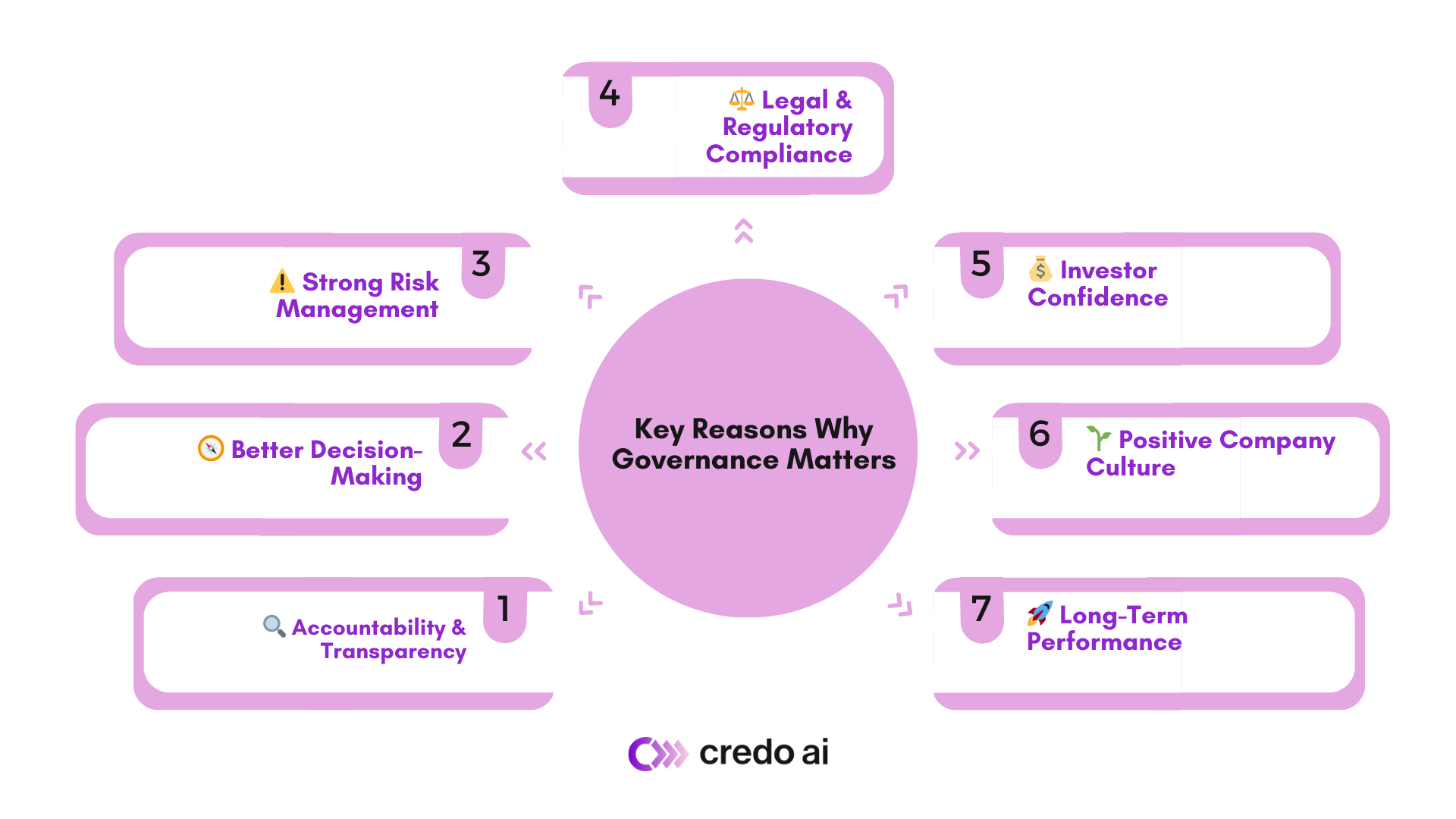
Why Governance Matters for Modern Organizations
Governance is critical for modern organizations as it provides a framework of accountability, transparency, and ethical conduct that drives performance, manages risks, builds stakeholder trust, and ensures long-term sustainability.
What Is Data Governance?
Data governance is the system of processes, policies, roles, standards, and technology ensuring an organization's data is secure, private, accurate, available, and usable throughout its lifecycle (creation to deletion). It defines who can do what, with which data, when, where, and how, enabling better decision-making, risk management, and compliance while fostering data-driven innovation and trust in data assets.
What Is AI Governance?
AI governance is the system of rules, policies, standards, and processes ensuring AI is developed and used ethically, safely, transparently, and in alignment with human values and laws, managing risks like bias, privacy issues, and misuse while balancing innovation with accountability for trusted AI. It sets guardrails for AI's entire lifecycle, from data curation and model training to deployment, focusing on fairness, explainability, security, and compliance with regulations (like the EU AI Act).
How Data Governance and AI Governance Work Together
Data governance provides the essential foundation and principles necessary for effective AI governance. While each discipline addresses unique challenges, a unified governance strategy ensures that AI systems are built upon reliable data while adhering to necessary ethical and regulatory standards.
Data Governance as a Foundation for AI Governance
Effective data governance establishes the policies and standards for managing data assets throughout their lifecycle—from creation to disposal. Key aspects include data quality, accessibility, security, and integrity. AI systems rely heavily on vast amounts of high-quality data for training and operation; therefore, robust data governance ensures the data used in AI is accurate, consistent, and trustworthy.
- Data Quality and Reliability: AI models are only as good as the data they consume. Data governance ensures data quality, which prevents the propagation of errors or biases into AI outputs.
- Data Privacy and Ethics: Data governance frameworks outline rules for handling sensitive information, which are directly inherited by AI governance to ensure AI applications respect user privacy and comply with regulations like GDPR or HIPAA.
- Auditability and Traceability: By establishing clear data lineage and documentation, data governance enables the tracing of data used to train AI models, which is crucial for auditing AI decisions and ensuring compliance.
Shared Challenges Across Both Frameworks
Both data and AI governance face common obstacles that necessitate a cohesive approach:
- Regulatory Complexity: Navigating a rapidly evolving landscape of data privacy laws and emerging AI regulations is a shared challenge.
- Bias and Fairness: While data governance addresses bias in the source data, AI governance tackles algorithmic bias, ensuring fairness in AI decision-making. Both require continuous monitoring.
- Transparency and Explainability: Ensuring that the origin and handling of data are transparent, and that AI decisions can be understood (explainability) are significant hurdles for both frameworks.
- Defining Ownership and Accountability: Establishing clear roles and responsibilities for data management and AI system oversight can be complex in large organizations.
Importance of Unified Governance Strategy
A unified governance strategy integrates data and AI governance into a single, cohesive framework, offering numerous benefits:
Consistency and Efficiency: Combining frameworks eliminates redundant processes and policies, ensuring consistent application of principles across all data and AI initiatives.
Holistic Risk Management: A unified approach provides a comprehensive view of risks, from the integrity of source data to the outcomes of AI model deployment, allowing for more effective mitigation.
Enhanced Compliance: Organizations can better manage compliance with interrelated regulations by leveraging a single oversight mechanism that covers both data management and AI usage.
Fostering Trusted AI Innovation: By providing clear guidelines and guardrails, a unified strategy empowers teams to innovate with AI confidently, knowing that their projects adhere to ethical and legal standards.
Governance Challenges in Practice
Governance challenges often manifest in practical operations through several key issues:
Lack of Standardized Processes
Without clear, consistent procedures, different teams or departments may develop their own approaches, leading to inefficiencies, increased risk of errors, and difficulty in cross-functional collaboration. This lack of uniformity can hinder compliance efforts and make it difficult to implement enterprise-wide policies effectively.
Limited Traceability and Documentation
Inadequate documentation and an inability to trace decisions, changes, or data flows make auditing difficult. This gap makes it challenging to pinpoint the source of issues, demonstrate compliance to regulators, or perform effective root-cause analysis, often resulting in a lack of accountability.
Visibility Gaps Across Teams
Silos between teams prevent a holistic view of governance activities. When one team is unaware of another's processes or data usage, it can lead to redundant efforts, conflicting priorities, and an inability to manage interdependencies, resulting in fragmented and inefficient governance.
Scaling Governance Across the Enterprise
Extending governance frameworks from a small department or project to an entire organization presents significant challenges. Scaling requires adapting processes to diverse business units, integrating different systems, fostering a consistent culture of compliance, and managing the sheer volume and complexity of information and regulations.
Choosing the Right Governance Approach
Choosing the right governance approach is about making smart, practical choices that fit your organization today and tomorrow. By understanding your current maturity, you can focus on what truly needs attention instead of overbuilding processes. When governance supports real business goals, it becomes an enabler, not a blocker. Flexible and scalable frameworks help teams respond to change without losing control. In the end, strong governance is not about more rules; it’s about clarity, trust, and better decisions that help the business move forward with confidence.
DISCLAIMER. The information we provide here is for informational purposes only and is not intended in any way to represent legal advice or a legal opinion that you can rely on. It is your sole responsibility to consult an attorney to resolve any legal issues related to this information.
.png)