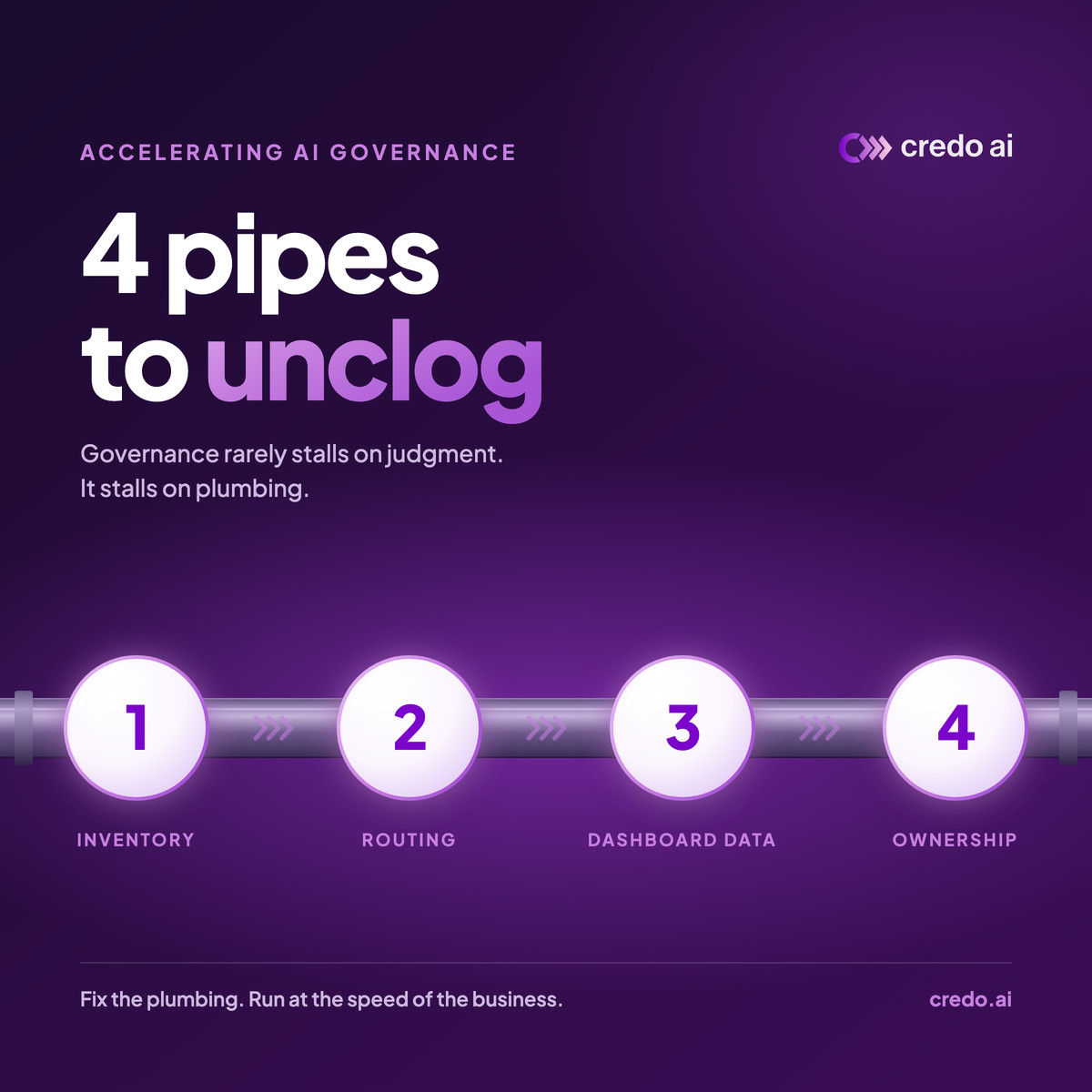
TL;DR In 2025, AI trust became non‑negotiable as enterprises moved AI into core operations and treated governance as infrastructure, not paperwork. Credo AI saw this shift firsthand: 2× year‑over‑year revenue growth, 150% growth in enterprise customers, 70% faster AI use‑case reviews, and 60% less manual AI compliance work for customers, laying the foundation for a trusted operating system for the AI stack in 2026 and beyond.
What structurally changed in 2025
2025 was the first year enterprises treated AI governance as required infrastructure rather than optional oversight.
This shift was not driven by regulation. Regulatory uncertainty remains relevant, but it did not fundamentally alter enterprise behavior. What changed was the depth and permanence of AI deployment inside organizations.
AI systems moved from peripheral experimentation into core operations. Third-party models were embedded into critical platforms. Agentic systems began initiating actions rather than simply generating outputs. AI increasingly influenced customer interactions, operational decisions, and regulated processes.
Once AI crossed that threshold, the questions leaders asked changed in kind:
- Where does sanctioned and unsanctioned AI usage exist across the organization?
- How do we approve AI use cases quickly without losing control?
- How do we understand risk when systems evolve continuously?
- How do we explain outcomes produced by multiple models, vendors, and agents?
- How do we remain accountable when outcomes emerge from systems rather than individuals?
- What is the real ROI of our AI investments?
These are not exploratory questions. They are operational questions that arise only when AI becomes business-critical. By 2025, many enterprises were operating at that level.
What Enterprises Learned in Production
One consistent lesson emerged across enterprise deployments: AI systems without governance rarely fail immediately. Instead, they become progressively harder to manage.
Before 2025, most organizations attempted to manage AI risk through fragmented approaches—manual reviews, spreadsheets, disconnected GRC tools, and static policy documents. At a small scale, these methods appeared workable. At production scale, they failed quietly, creating critical gaps in visibility and control.
AI initiatives slowed not because teams lacked ambition or technical capability, but because organizations struggled to assess and communicate risk clearly. Scaling became difficult when systems could not be explained or defended with confidence. Decision-making stalled when evidence was fragmented or unavailable.
When governance was treated as documentation, it added little value. When it was treated as infrastructure embedded into workflows, outcomes changed materially.
Across Credo AI customers in 2025, organizations achieved:
- 70% faster AI use-case reviews
- 60% reduction in manual AI compliance effort
- 3× improvement in executive-level AI risk reporting

Credo AI Customer Advisory Board Meeting 2025 @ New York Stock Exchange
These results did not come from adding controls. They came from replacing ambiguity with structure—clear ownership, consistent evidence, and shared understanding of risk across teams. In practice, this allowed organizations to move faster with confidence rather than hesitation.
What Credo AI’s Growth Reveals about the Market
Credo AI’s momentum in 2025 reflected these same structural shifts.
It is important to be precise about what drove that growth. Regulatory uncertainty played a role, but it was not the primary catalyst. Enterprises did not engage Credo AI to prepare for hypothetical requirements. They engaged with us because they were already operating AI systems that were difficult to explain, defend, or scale without governance.
Three needs consistently drove adoption:
1. Rapid adoption of third-party AI systems across the enterprise
2. Embedding AI into real, business-critical use cases rather than pilots
3. Maintaining accountability and defensibility over time, as systems evolved
By 2025, AI governance decisions increasingly involved CIOs, CDOs, CTOs, risk leaders, and board committees—not innovation teams alone. Purchases were triggered when AI systems entered environments where accountability, auditability, and reputational exposure mattered.
Budgets shifted accordingly, from exploratory spend to core operational infrastructure.
As a result, Credo AI saw:
- 2× year-over-year revenue growth
- 150% growth in enterprise customers
- 2× expansion across Europe
- 40+ strategic partners embedding governance in production
- Launches on AWS and Microsoft Azure marketplaces
- 5× growth in advisory engagements
These outcomes reflect market pull rather than promotion. Governance shifted from precautionary spending to required infrastructure for operating AI at scale.
Innovation Built for Autonomous Systems
As AI systems became more autonomous in 2025, risk shifted from outputs to actions. Governance requirements began compounding rather than scaling linearly.
Credo AI’s product roadmap reflected this shift.
Credo AI Agent Registry (Public Preview) was built for a world where AI agents don’t just respond—they act. A single agent can access sensitive data, trigger workflows, interact with customers, and escalate decisions. That’s dozens of risk vectors in motion.
Agent Registry gives enterprises visibility and control from day one, making governance agent-native rather than reactive.
In an agentic world, shadow AI isn’t just a policy problem. It’s an existential one. Discovery allows leaders to surface that risk and bring it into governance without shutting down innovation.
Shadow AI Discovery tackles a quieter but equally urgent issue. Every enterprise has AI operating outside formal oversight—tools adopted informally, pilots drifting into production, third-party integrations creating hidden exposure.
Interestingly, smaller businesses may be even more exposed: in companies with just 11–50 people, 27% of employees are using AI apps without approval. Without formal governance or dedicated security teams, these organizations may carry a disproportionately high shadow-AI risk per capita.
Governance as an Operating Discipline
One clear pattern this year was that governance challenges rarely exist in isolation. They surface at the intersection of systems, organizations, and decision-making.
This drove the launch and expansion of Credo AI’s Advisory Services in 2025. Embedding Forward-Deployed AI Governance Experts inside organizations such as Autodesk and Madrigal Pharmaceuticals enabled teams to address questions that tooling alone cannot resolve:
- Ownership of AI risk across teams and vendors
- Escalation paths and review thresholds
- Evidence requirements for executive and board oversight
- Alignment between technical decisions and organizational accountability
When governance is treated as an operating discipline rather than a compliance task, it reduces friction instead of creating it.
Governance Where AI Actually Runs
Another lesson from 2025 was practical: governance that sits outside the AI stack does not hold under pressure.
As AI is built, deployed, and procured through existing enterprise environments, governance must be present in those environments to be effective. This informed Credo AI’s 2025 focus on integration and ecosystem alignment
- Our integration with Microsoft Azure AI Foundry brought Credo AI directly into Azure Marketplace.
- Our collaboration with IBM made Credo AI Policy Packs the foundation for compliance accelerators in watsonx.governance.
- Our AWS Marketplace and Azure Marketplace presence removed procurement friction entirely.
These steps were taken to align governance with how AI is actually developed and operated.
External signals of a maturing category
As AI governance moved into the operational core of enterprise strategy, external recognition followed.
In 2025, Credo AI was named:
- Leader in The Forrester Wave™: AI Governance Solutions (Q3 2025)
- Recognized across multiple Gartner reports including
- Gartner AI TRiSM Market Guide
- Gartner Cool Vendor 2025, and
- Gartner Market Guide for AI Governance Platforms (2025)
- Major Player- IDC Unified AI Governance Platforms 2025
- Fast Company named us among the Next Big Things in Tech
- CB Insights included us in the AI 100.
I was also honored to participate in broader industry conversations, including
TIME’s 100 AI 2025 , Inc. Female Founders List TIME’s 100 AI 2025, discussions on CNBC, Fortune AI Brainstorm, and features with the NYSE Inside the ICE House and on the Nasdaq tower.

These signals matter not as endorsements, but as indicators that AI governance has become central to how enterprises and governments approach AI deployment.
Bringing AI Leaders Together to Lead with Trust
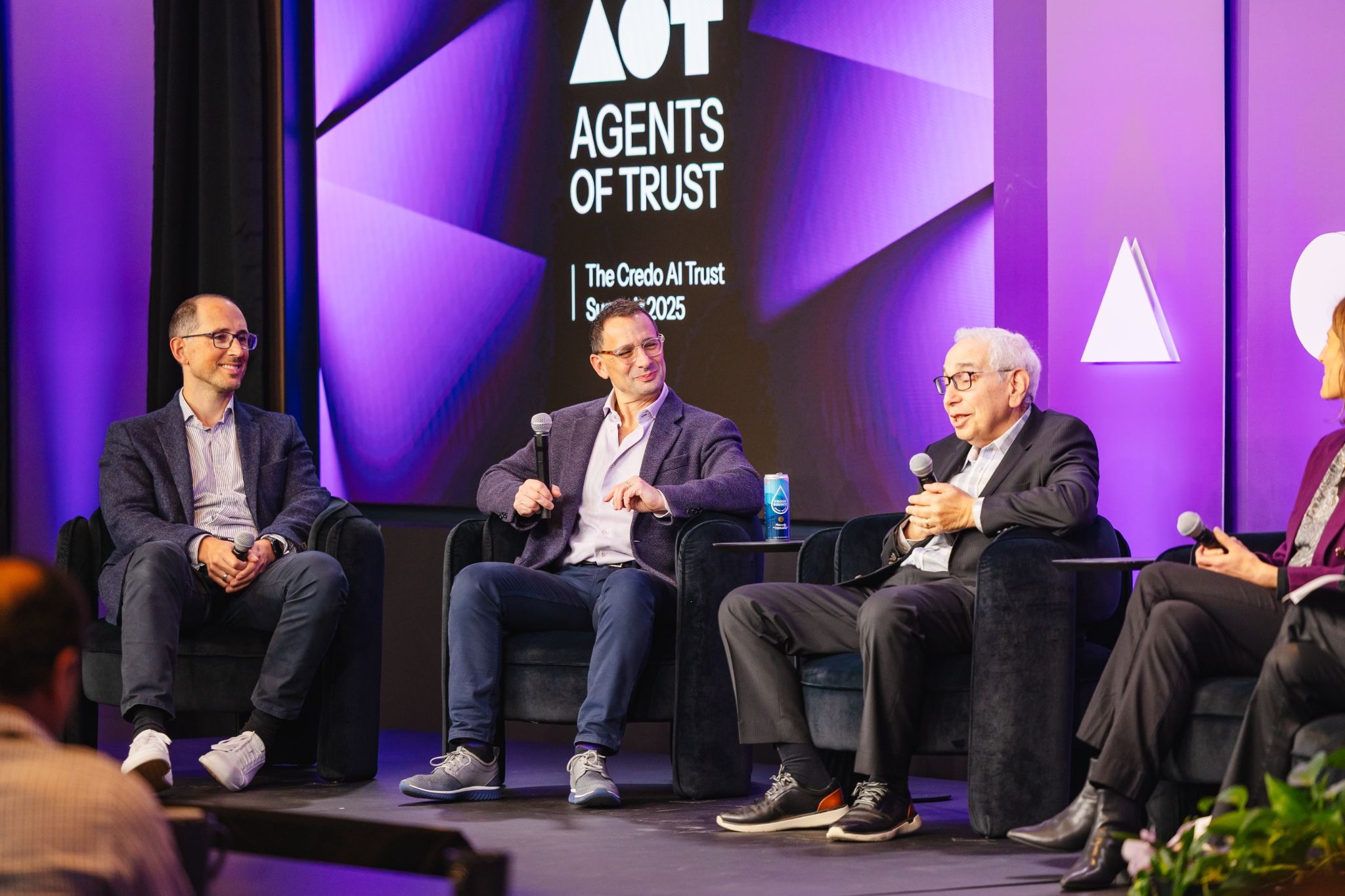
In September, we hosted the Credo AI Trust Summit, bringing together hundreds of practitioners and leaders we call “Agents of Trust.” The goal wasn’t thought leadership for its own sake—it was practical alignment around a shared challenge:
Intelligent systems and human leadership must evolve together, or trust becomes performative.

The conversations that started there are now shaping boardroom discussions, operating models, and AI strategies across industries. If you missed it, you can check out our Virtual Summit replays at your own leisure.
Investing for the Long Term
In 2025, we also made a deliberate investment in Credo AI’s long-term presence by moving into our new San Francisco headquarters.
This space is more than an office. It is now our home—a place where we build, connect, and work closely with customers, partners, policymakers, and collaborators. It reflects the permanence of the work ahead and our commitment to serving organizations deploying AI at enterprise and national scale.

As AI governance becomes foundational infrastructure, proximity matters. Being embedded in innovation ecosystems allows us to stay close to operational realities—not just theory.
Looking ahead, we expect to expand our presence into additional global innovation centers as enterprise and government demand for trusted AI governance continues to grow.
Building the Trusted Operating System for the AI Stack
What 2025 ultimately made clear is that trust in AI is no longer aspirational. It is operational.
As AI systems become more autonomous, interconnected, and embedded into enterprise and public-sector workflows, trust must be engineered deliberately. It must be measurable, repeatable, and defensible over time. Without that foundation, scale becomes fragile. With it, organizations can operate decisively.
If the last phase of enterprise AI was about building systems, the next phase in 2026 will be about running them—consistently, defensibly, and at scale. For executives seeking a playbook to help them build their AI governance stature and ROI in 2026, we’ve created a guide for you. Download our latest playbook here.
Quantifiable trust is not an add-on.
It is the operating system that makes this future viable.
At Credo AI, we have been building toward this reality for nearly half a decade—not because it was easy, but because it was inevitable.
The real work has now begun.
To our customers: thank you for trusting us and for leading from the front.
To our partners: thank you for extending our mission and helping trusted AI scale globally.
To Credoers: thank you for turning vision into execution every single day.
And we’re just getting started.
DISCLAIMER. The information we provide here is for informational purposes only and is not intended in any way to represent legal advice or a legal opinion that you can rely on. It is your sole responsibility to consult an attorney to resolve any legal issues related to this information.
.png)