For AI governance leaders, legal and compliance teams, and procurement professionals, the pressure to build trustworthy, compliant AI systems has never been greater. New regulations are emerging across jurisdictions. Risk frameworks are multiplying. And the expectations placed on your team and the reality of rapid agent adoption are widening the gap between AI deployment and AI governance. Organizations are rolling AI out across departments, but only a fraction are governing it at scale. Whether you’re standing up a governance program for the first time or trying to scale trust across an enterprise AI portfolio, teams keep running into the same foundational question: where do we start, and how do we keep up?
The Problem: Governance Intelligence Is Fractured
The challenge isn’t that governance information doesn’t exist — it’s that it’s scattered across dozens of sources, written in incompatible formats, and disconnected from the relationships that make it actionable.
Risk taxonomies live in one place. Regulatory text lives in another. The mapping between “what could go wrong” and “what to do about it” is buried across frameworks from NIST, ISO, the EU AI Act, and dozens of other standards bodies. And none of these sources talk to each other.
For legal and compliance teams, the burden is keeping pace. AI regulations are spread across government websites, written in dense legal language, and constantly evolving. Tracking what applies to your organization requires ongoing effort that pulls focus from higher-value compliance work.
For AI Governance and Risk Leaders the challenge is fragmentation and clear best practices. What risks are most relevant as organizations increasingly bring agents into their core business? And what controls are critical at an organizational and system level?
Across all of these roles, the root problem is the same: the governance intelligence you need to act on is too fragmented, too disconnected, and too difficult to keep current.
The Foundation: Continuously Synthesized Governance Intelligence
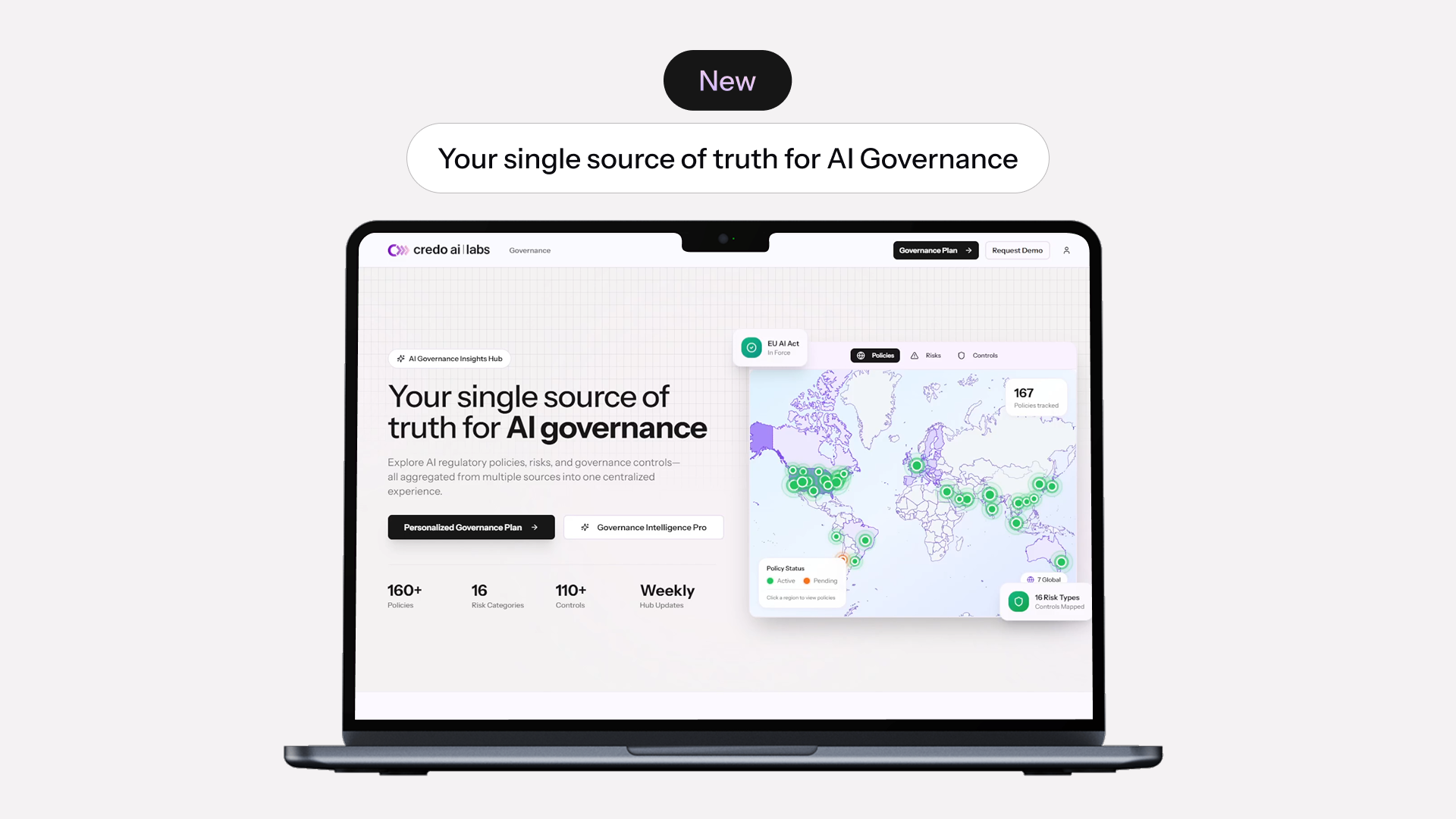
Credo AI built the AI Governance Insights Hub as a free resource for the ecosystem — but not simply as a content library. The Hub is powered by Credo AI’s Harmonized Controls Framework (HCF): a structured knowledge graph that connects global AI regulations, risk scenarios, and governance controls into a single, continuously maintained system.
This is the critical distinction. The raw ingredients of AI governance — risk descriptions, control catalogs, regulatory text — are increasingly available from public sources. What doesn’t exist anywhere else is the synthesis: the harmonized relationships between regulations, risks, and controls, maintained by Credo AI’s governance intelligence team and continuously enriched by community feedback from practitioners using the Hub every day.
The Hub currently tracks:
- 100+ global regulations
- 80 risk scenarios across 16 risk categories
- 100+ governance controls — all interconnected and updated weekly
But the numbers matter less than the structure. Every regulation links to the specific risks it addresses. Every risk links to the controls that mitigate it. Every control links back to the policy requirements it satisfies. These cross-cutting relationships are what make the intelligence actionable rather than just informational.
Here’s What The Hub Means for You
If you’re leading AI governance and risk
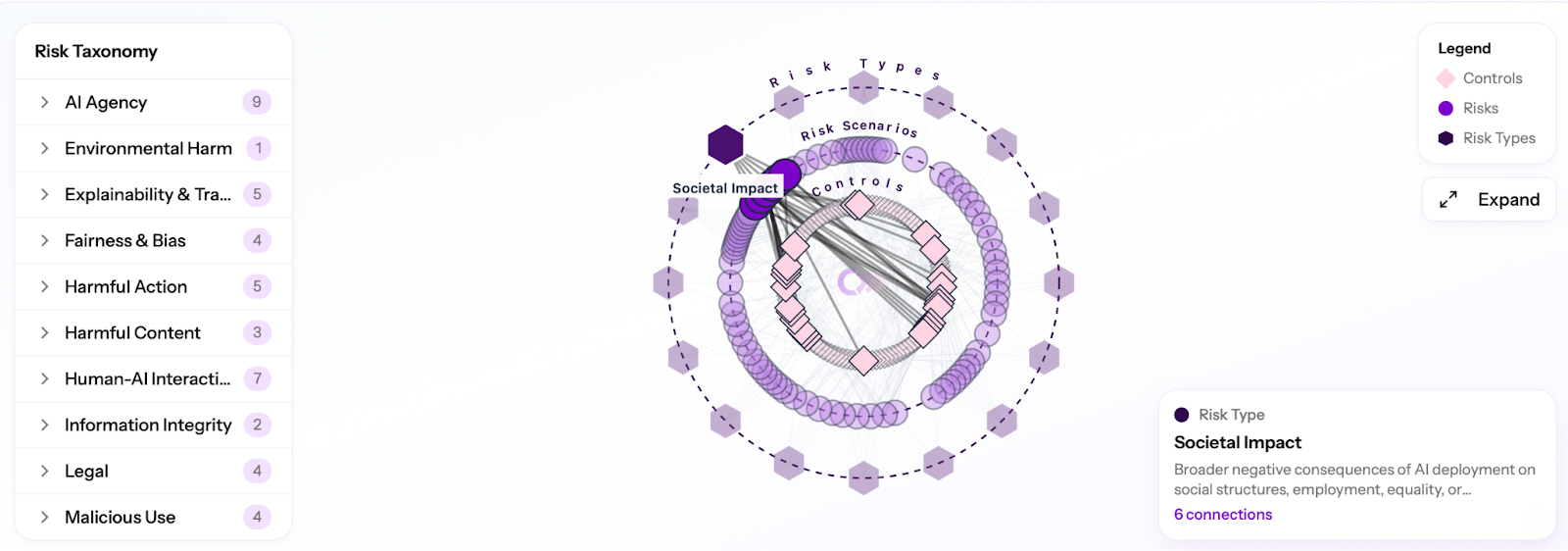
You’ve been reconciling risk taxonomies from MIT, NIST, ISO, and others manually, a time-consuming process that delays action and introduces inconsistency. The Hub gives you a unified, harmonized risk and control framework spanning fairness, security, privacy, transparency, and eleven additional categories, covering 16 risk types across 80 scenarios. Instead of building from scratch or reconciling competing frameworks, you start with the most comprehensive harmonized taxonomy available.
The Governance Graph makes the relationships between risk types, individual risk scenarios, and governance controls visible and navigable. Click any node and see exactly what it connects to across layers — from a broad risk category down to the specific controls that mitigate it and the policies that require it. This is the map your program has been missing.
And intelligence improves through use. Practitioners across the ecosystem rate control effectiveness, assess risk severity and likelihood, and score implementation difficulty based on real-world experience. This community signal means you’re not just relying on expert-curated taxonomies — you’re building on practitioner-validated intelligence about what actually works.
If you’re on a legal or compliance team
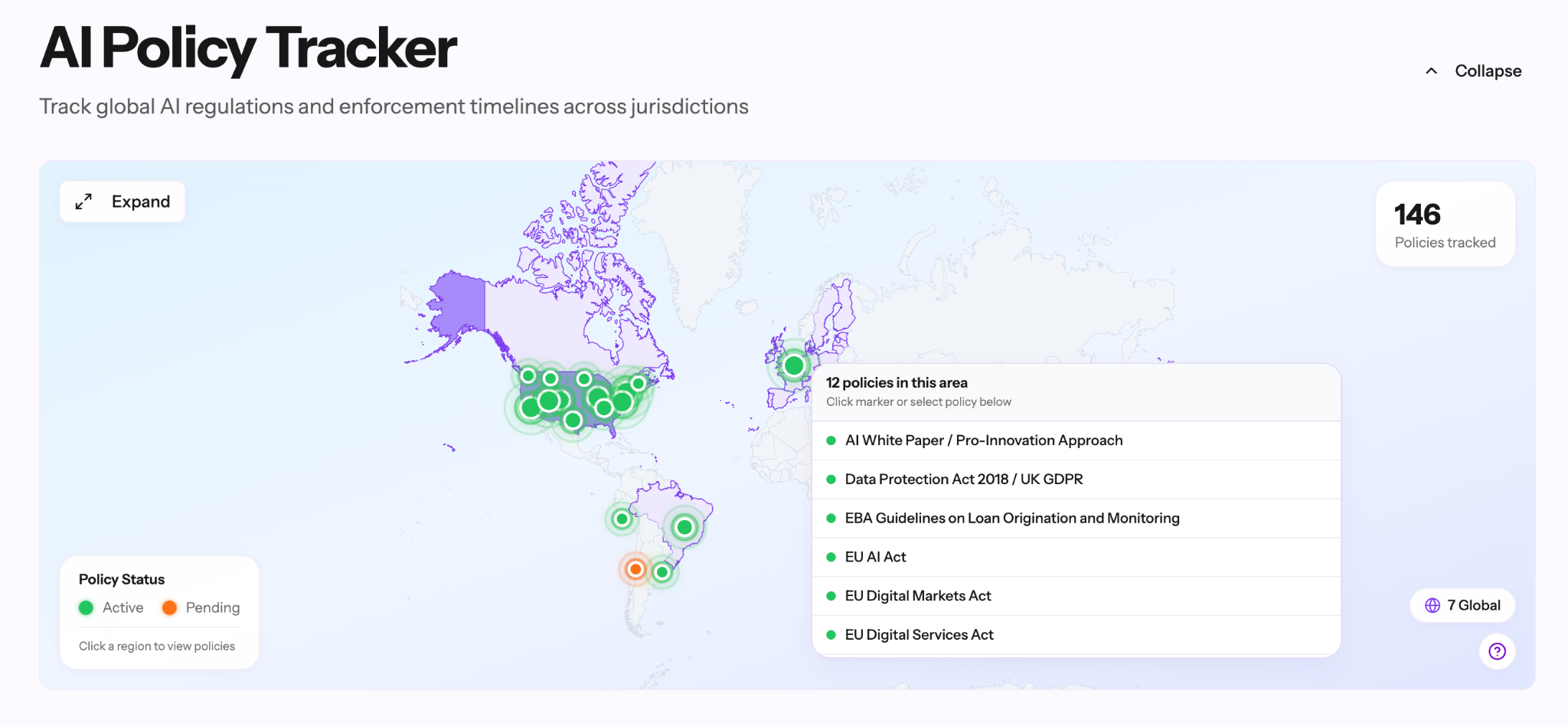
You need one place to see what regulations apply to your organization, what they require, and when enforcement begins. The Hub’s Regulatory Intelligence provides a comprehensive database of AI regulations with plain-language explanations, a global jurisdiction map, and enforcement timelines. Instead of chasing PDFs across government websites, you get a single, continuously updated source of truth.
Filters let you drill into regions, legislative status, and policy types. The interactive world map shows where regulations apply geographically with click-through to full policy details. When a new regulation passes or an enforcement date shifts, it’s reflected in the Hub — you’re not working from a stale snapshot.
Apply It to Your Context — At Any Stage of Maturity
The Personalized Governance Insight Flow isn’t just a way to get started — it’s the starting point for applying governance intelligence to your specific context, whether you’re building your first program or pressure-testing a mature one.
In a guided flow, you specify your AI system type, industry, jurisdictions, risk priorities, and policy focus. The Hub then surfaces a prioritized governance plan: the most relevant risk scenarios ranked by severity, recommended controls with implementation reasoning for each risk, applicable policies with enforcement dates, a gap analysis identifying unmitigated risks, and high-impact controls that address multiple risks simultaneously.
As an example, a healthcare RAG chatbot in the EU faces different governance requirements than a financial ML model in the US. The insight flow surfaces exactly what’s relevant to your situation — and produces an output you can share across stakeholders, revisit as your context evolves, and use as the foundation for governance decisions.
See the Relationships. Build on Collective Experience.
Complex governance relationships are hard to reason about in spreadsheets and documents. The Hub’s interactive visualizations make them navigable: a global regulation map showing where AI policies apply, a governance graph revealing how risks connect to controls and controls connect to policies, and a mitigation taxonomy view that maps the full control hierarchy. These aren’t decorative — they’re working tools for understanding your governance landscape.
The Hub’s community features create a feedback loop that makes the intelligence better over time. Practitioners vote on whether controls actually mitigate risks in practice, rate implementation difficulty from real-world experience, and propose new controls that the community can evaluate. An activity feed shows what’s happening across the ecosystem in real time. The result is governance intelligence that reflects not just expert analysis, but the accumulated operational experience of teams doing this work every day.
Stop Building in the Dark
The organizations that will build trustworthy AI systems aren’t the ones with the most resources. They’re the ones with the clearest picture of what governance applies to them and what to do about it. That clarity requires a foundation you can trust.This trust is engendered from a solution that’s continuously maintained, structurally sound, and enriched by the practitioners who refine it.
The AI Governance Insights Hub gives your team that foundation, for free.
Try the AI Governance Insights Hub today →
Frequently Asked Questions
What is the AI Governance Insights Hub?
The Hub is a free resource built by Credo AI that serves as a single source of truth for AI governance. It’s powered by Credo AI’s Harmonized Controls Framework — a structured knowledge graph connecting global AI regulations, risk scenarios, and governance controls. The intelligence is continuously maintained by Credo AI’s governance team and enriched by community feedback from practitioners.
How does the Hub help legal and compliance teams stay on top of AI regulations?
The Hub aggregates AI regulations across global jurisdictions, translates them into plain language, and tracks enforcement timelines. Instead of monitoring multiple government sites, compliance teams get one centralized, continuously updated view of what applies to their organization and when.
Can the Hub support procurement and vendor risk assessments?
Yes. The Risk and Control Framework Library provides a unified taxonomy covering 16 risk types and 80 scenarios across fairness, security, privacy, and transparency. Procurement teams can use this as a consistent foundation for evaluating AI vendor risk without building a framework from scratch. Community ratings on control effectiveness and implementation difficulty add practical context.
What if I already have a governance program?
The Personalized Governance Insight Flow is designed for teams at any maturity level. It applies the Hub’s intelligence to your specific context — your AI system types, industry, jurisdictions, and risk priorities — and produces a prioritized output with gap analysis and high-impact control recommendations. It’s as useful for pressure-testing an existing program as it is for building a new one.
What makes this different from public frameworks like NIST or the MIT AI Risk Repository?
Public sources provide valuable raw material — risk descriptions, control catalogs, regulatory text. What they don’t provide is the synthesis: harmonized, cross-cutting relationships between regulations, risks, and controls that let you trace from a policy requirement to the controls that satisfy it to the risks it addresses. That structured intelligence, continuously maintained and enriched by community feedback, is what the Hub delivers.
DISCLAIMER. The information we provide here is for informational purposes only and is not intended in any way to represent legal advice or a legal opinion that you can rely on. It is your sole responsibility to consult an attorney to resolve any legal issues related to this information.
.png)
.png)