

AI Law
AI laws are legally binding rules that govern how AI systems are developed, deployed, and used. They usually define where the law applies, which AI systems fall under its scope, how systems are classified by risk, what obligations organizations must follow, what rights individuals have, and how violations are enforced.
In AI governance, law sets the minimum compliance standard, while regulations add technical detail, and internal policies help organizations operationalize those requirements. Examples like the EU AI Act and NYC Local Law 144 show how AI law is emerging across global, national, regional, and municipal levels.
.png)
How AI Laws Are Structured
AI laws vary in scope and approach, but most share a common structure.
- Jurisdiction and applicability: A law applies within a defined territory, such as national, regional, or municipal, and typically specifies which organizations and AI use cases fall under its scope.
- Risk-based classification: Many AI laws organize their requirements around risk tiers. Higher-risk AI applications that are used in healthcare, critical infrastructure, employment, or law enforcement face stricter obligations around transparency, documentation, human oversight, and testing. Lower-risk applications face lighter requirements or none at all.
- Obligations and rights: AI laws typically impose obligations on AI developers and deployers, such as maintaining technical documentation, conducting impact assessments, or registering systems with a regulatory authority, while establishing corresponding rights for individuals, such as the right to explanation or the right to contest an automated decision.
- Enforcement mechanisms: Laws are backed by enforcement, with regulatory bodies empowered to investigate, impose fines, and require remediation. The scale of penalties varies significantly; for instance, the EU AI Act sets maximum fines based on a percentage of global annual revenue.
Why AI Law Matters in Governance
For organizations building or deploying AI, law sets the floor. Internal AI policies and voluntary standards may go further, but legal requirements represent the minimum threshold below which an organization cannot operate without risking liability.
Understanding the legal landscape is foundational to AI risk management. Non-compliance doesn't just mean fines; it can mean forced suspension of AI systems, reputational damage, and loss of customer or partner trust.
As AI laws multiply across jurisdictions, organizations operating globally face the challenge of tracking overlapping and sometimes conflicting requirements simultaneously.
Law also shapes what governance structures organizations need to have in place. Many AI laws require organizations to designate responsible parties, maintain audit trails, conduct conformity assessments, and document how systems work; these are the requirements that need to be operationalized through internal governance programs, not just legal review.
Real-World Examples
Example 1: EU AI Act
The EU AI Act is the most comprehensive AI-specific law enacted to date. It categorizes AI systems by risk level - unacceptable, high, limited, and minimal and imposes tiered compliance obligations accordingly.
High-risk AI systems, such as those used in hiring, credit scoring, and biometric identification, must meet requirements around data governance, transparency, human oversight, and accuracy before they can be deployed in EU markets.
The Act also prohibits certain AI practices outright, such as real-time remote biometric surveillance in public spaces for law enforcement purposes.
Example 2: NYC Local Law 144
New York City's Local Law 144 requires employers using automated employment decision tools to conduct annual bias audits and publish the results publicly before using such tools in hiring or promotion decisions affecting New York City residents.
It is one of the first laws in the United States to impose specific technical and transparency requirements on AI used in employment, illustrating how AI law is emerging at the municipal level, not just nationally.
Law vs. Regulation vs. Policy in AI
These three terms are often used interchangeably, but they mean different things in practice.
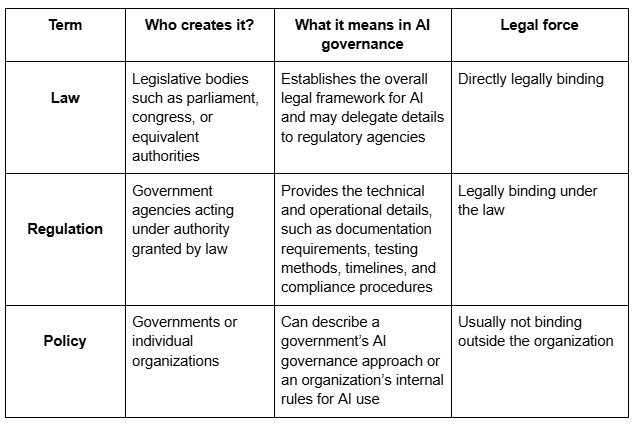
Understanding this distinction matters because compliance requires navigating all three layers: what the law requires, what regulations specify, and what internal policies must implement.
Summary
Law in the context of AI refers to government-enacted, legally binding rules that govern how AI systems are built and used. AI laws are multiplying across jurisdictions, establishing obligations for organizations around transparency, documentation, risk assessment, and accountability while giving individuals rights over how AI affects them.
For any organization developing or deploying AI, understanding the applicable legal landscape isn't optional: it's the starting point for responsible AI governance.
Frequently Asked Questions
Here you can find the most common questions.
Does AI law apply to every company using AI?
Not always. AI laws usually apply based on geography, industry, risk level, and how the AI system is used.
What’s the difference between AI law and AI ethics?
AI ethics is based on principles like fairness, transparency, and accountability. AI law turns some of those principles into enforceable legal rules.
How do organizations keep up with AI laws across multiple jurisdictions?
They track legal updates, map laws to their AI systems, and manage compliance through ongoing AI governance programs.