AI is already inside your business processes: approving, routing, scoring, and flagging things in the background.
And that’s exactly why AI governance matters, making sure those invisible decisions are fair, compliant, and under control.
If BPM is how work moves through your organization, governance shapes how AI behaves inside those movements, making automation faster and TRUSTED.
Let’s discuss what this integration looks like and how to make it part of the processes you run today.
Key Takeaways
- AI governance is critical when AI runs inside business processes: It ensures automated decisions are fair, secure, compliant, and under control.
- BPM defines how work flows, AI governance defines how AI behaves: Together, they enable automation that is scalable, transparent, and reliable.
- Governance reduces risk as AI use grows: Clear policies, monitoring, and ownership help manage bias, data privacy, security, and regulatory requirements.
- Strong governance enables trusted AI adoption: With the right controls in place, teams can move faster, improve processes, and use AI with confidence.
What is AI governance?
AI governance is the system of policies, standards, and practices that guide how AI is built and used so its decisions stay safe, fair, transparent, and compliant with regulations. It helps organizations manage risks, prevent bias, protect data, and keep AI accountable as it runs inside everyday workflows.
According to Gartner’s Market Guide for AI Governance Platforms (2025), by 2028, governance technologies will decrease regulatory compliance costs by 20%, enabling 10% more investment in strategic growth initiatives.
Key Aspects of AI Governance
- Risk management: Identifying and addressing issues like bias, security gaps, or privacy risks so AI behaves reliably and doesn’t create unexpected harm.
- Ethical alignment: Making sure AI decisions are fair, transparent, and accountable, and that the system reflects your organization’s values.
- Regulatory compliance: Setting clear policies and controls to meet legal and industry requirements, including upcoming AI-specific regulations.
- Oversight and monitoring: Continuously tracking model performance, spotting drift or errors early, and making timely adjustments to keep AI on track.
- Stakeholder involvement: Bringing together IT, compliance, business teams, and leadership so AI decisions are shared, informed, and responsibly guided.
What is Business Process Management (BPM)?
Business Process Management (BPM) is the practice of understanding, improving, and managing how work flows across an organization so teams can operate more efficiently, reduce costs, and deliver better outcomes. It’s a continuous cycle that uses people, systems, and automation to keep processes consistent, scalable, and aligned with business goals.
Key Aspects of BPM
- Analyze: Look closely at existing processes to spot inefficiencies, bottlenecks, and opportunities for improvement.
- Design/Model: Map out how the process should work, often using visual models to create clearer, more efficient workflows.
- Execute: Put the redesigned process into action across people, tools, and automation systems.
- Monitor & Measure: Track performance with data to see whether the process meets expectations or needs adjustment.
- Optimize: Continuously refine the process based on insights, leading to smoother operations and stronger results over time.
Why AI-Enabled BPM Demands Strong AI Governance Controls
To understand why governance becomes essential, let’s look at what AI actually changes inside a BPM workflow.
At a high level, the biggest shifts show up in five areas:
- Ethics and Fairness in Automated Decisions
- Transparency and Explainability in AI-Driven Workflows
- Staying Ahead of AI Regulations
- Managing Operational and Security Risks
- Clear Ownership and Accountability
- Building and Keeping Stakeholder Trust
Ethics and Fairness in Automated Decisions
AI learns from data. If that data is biased, your automated decisions can be biased too, sometimes in ways that are hard to spot.
In areas like hiring, lending, insurance, or performance reviews, these can quickly lead to unfair outcomes.
AI governance helps by:
- Requiring bias testing before and after deployment
- Setting standards for fair use of data
- Ensuring different user groups are treated equitably
Transparency and Explainability in AI-Driven Workflows
Classic BPM is usually rule-based: if X happens, do Y. AI models don’t always work that way. They can feel like a “black box,” which is a problem when someone asks, “Why was this approved?” or “Why was this person declined?”
AI Governance brings structure here by:
- Defining when explanations are required
- Setting expectations for model documentation
- Choosing or supporting models that can be explained in human terms
Staying Ahead of AI Regulations
Regulation is catching up with AI fast. Frameworks like the EU AI Act, data protection laws such as GDPR, and local rules (like India’s data protection laws) are raising the bar for how AI can be used in business processes. According to Gartner’s Market Guide for AI Governance Platforms (2025), the Impact of the EU AI Act and emerging global regulations is driving AI compliance spend toward $1B by 2030.
Without governance, AI embedded in BPM can:
- Mishandle personal data / personal identifiable information
- Violate industry rules
- Create non-compliant decisions at scale
AI governance helps teams:
- Translate regulations into clear internal policies
- Document how AI is used inside processes
- Show auditors exactly how decisions are controlled and monitored
- Help organizations understand what AI tools are used by employees
Managing Operational and Security Risks
AI systems don’t fail in the same way traditional workflows do. They fail through hallucinations, model drift, prompt injections, or even adversarial attacks designed to confuse them.
Strong AI governance keeps these risks in check by requiring continuous monitoring, regular risk assessments, clear fail-safe mechanisms, and defined incident-response steps.
Strong AI governance keeps these risks in check through:
- Continuous monitoring to spot unusual behavior early
- Regular risk assessments as models evolve
- Fail-safe mechanisms that stop flawed decisions from moving forward
- Clear incident-response steps when something goes wrong
When these controls are in place, AI-enabled processes stay resilient, secure, and far more reliable.
Clear Ownership and Accountability
In a complex AI-enabled workflow, it’s easy to lose track of who is trusted for what. Was it the model? The data? The process owner? The vendor?
AI governance adds clarity by:
- Assigning ownership for each AI system
- Defining roles for business, IT, risk, and data science
- Making sure someone is accountable for outcomes, not just models
Building and Keeping Stakeholder Trust
Employees and customers are more likely to question AI-driven decisions than traditional ones, especially if they don’t understand how those decisions are made.
When there’s no governance, that uncertainty can slow or block AI adoption altogether.
With strong AI governance in place:
- Teams know how AI is being used, and where it isn’t
- Users can challenge or escalate questionable outcomes
- Leadership can confidently support AI initiatives
Trust becomes an asset, not an afterthought.
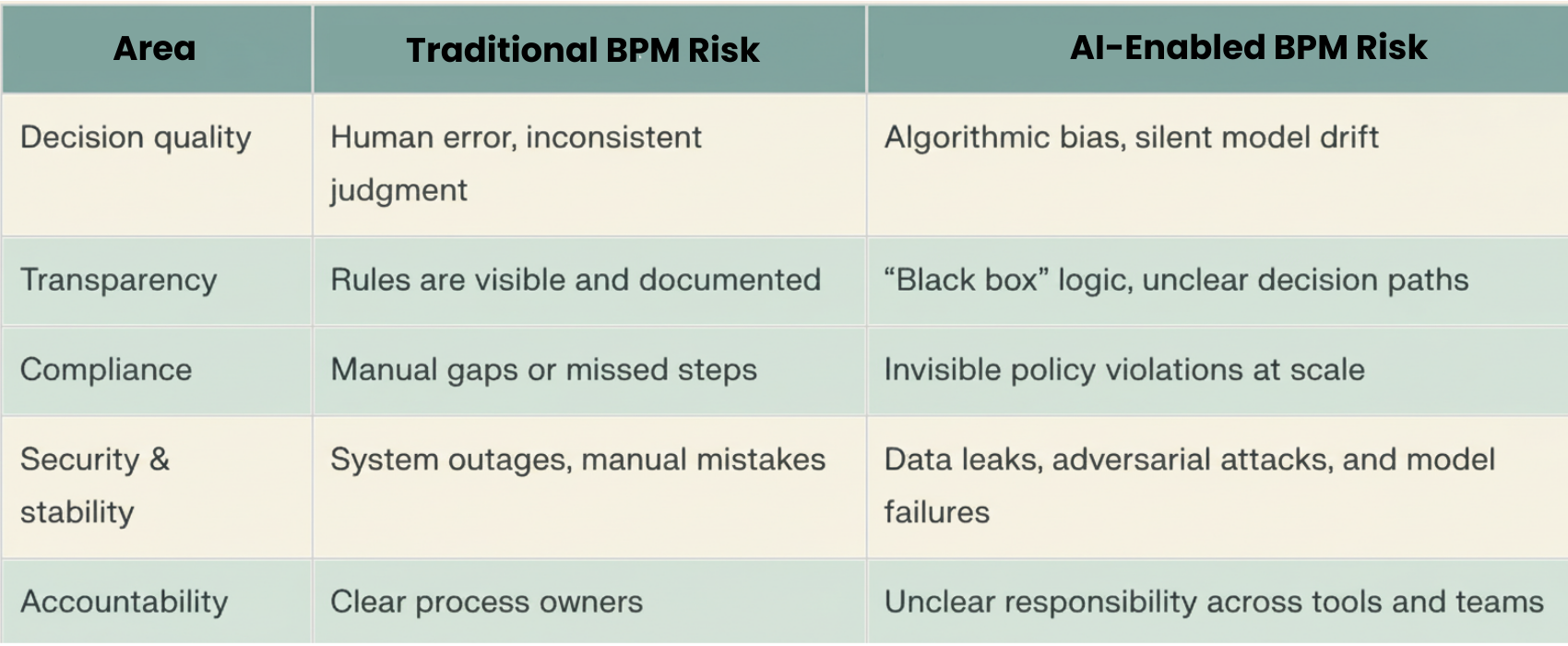
Traditional BPM Risks vs. AI-Enabled BPM Risks
You can also think about it this way:
The Integration Framework: Embedding AI Governance into BPM
Before we dive in, it’s worth looking at how AI governance actually strengthens the day-to-day controls your processes rely on.
- Stronger Compliance and Risk Control:
- Automated checks: AI can continuously review processes against internal policies and external regulations, catching deviations in real time and reducing the burden of manual oversight.
- Proactive risk mitigation: Governance helps AI flag early signals of fraud, errors, or process failures so issues can be corrected before they affect customers or compliance.
- Better Decision-Making and Higher Accuracy:
- Data-driven insights: With AI analyzing patterns and trends, teams gain clearer visibility into how their processes behave and where improvements can be made.
- Predictive capabilities: AI can anticipate bottlenecks or shifts in demand, enabling managers to optimize workflows before they slow down.
- Greater Transparency & Trust:
- Explainablity: Governance ensures AI decisions can be understood and justified, a critical factor for internal teams, regulators, and customers.
- Ethical frameworks: Clear ethical guidelines help keep AI fair and unbiased, building confidence across both employees and the people your processes serve.
- Higher Efficiency and Productivity:
- Smarter automation: AI can take on more complex tasks, such as document review, classification, or routing, freeing teams to focus on work that needs human judgment.
- Continuous improvement: As AI learns from new data, governed processes evolve and refine themselves, driving steady gains in quality and efficiency.
- Improved Data Quality and Security:
- Secure handling: Governance ensures sensitive data used by AI is managed responsibly, reducing security risks.
- Higher data quality: Good governance also means better control over data sources, leading to more reliable model behavior and fewer downstream issues.
- Greater Agility and Room for Innovation:
- Adaptability: AI-enabled processes can shift quickly as market or operational conditions change, while governance keeps those adjustments safe and controlled.
Safe experimentation: Governance creates a structured environment where teams can test new AI capabilities without exposing the organization to unnecessary risk.
Facing challenges? Talk to an AI Governance Expert
Strategies for Trusted AI Adoption
Have a look at these practical ways to manage these challenges and keep AI use responsible.
- Create a Governance Framework: Set policies, define roles, and review AI use cases before deployment.
- Use Explainable AI (XAI): Choose models that make decisions easy to understand and justify.
- Keep Humans in the Loop: Maintain human review for critical or high-impact decisions.
- Improve Data Readiness: Clean, secure, well-governed data leads to more reliable AI.
- Audit Regularly: Check for drift, bias, and compliance gaps on an ongoing basis.
- Train Teams: Help employees understand how AI supports their work and how to use it responsibly.
Credo AI Strengthens AI Governance in Your BPM
If you’re looking for a trusted AI governance solution, Credo AI delivers a centralized, end-to-end governance layer purpose-built to integrate seamlessly with your BPM ecosystem.
It provides the visibility, oversight, and control that traditional process tools simply can’t offer.
With capabilities such as:
- Automated policy enforcement
- Continuous risk and performance monitoring
- Robust model explainablity and documentation
Credo AI gives you complete transparency into how models behave across your workflows.
These safeguards ensure your AI systems operate safely, ethically, and in alignment with both internal standards and external regulatory requirements.
The result? You accelerate innovation, reduce compliance burden, and build AI-enabled processes your teams and stakeholders can trust.
Explore the Credo AI Governance Platform
Wrapping Up
As organizations lean deeper into AI-enabled BPM, having a partner like Credo AI helps ensure that innovation and trusted AI grow side by side.
With the right governance foundation in place, automation becomes not just faster, but dependable, transparent, and built for the long run.
DISCLAIMER. The information we provide here is for informational purposes only and is not intended in any way to represent legal advice or a legal opinion that you can rely on. It is your sole responsibility to consult an attorney to resolve any legal issues related to this information.
.png)