TLDR;
- Multi Agent systems are challenging the status quo of accountability and governance.
- Shadow AI usage is a growing concern for enterprises and parents.
- Sovereign AI emerged as a priority for government leaders in Davos.
- Policy needs to reflect use-case context and sector-specific risks.
- It’s time to shift the AI narrative by showcasing impactful AI use cases.
This year in Davos marked a critical inflection point in global AI governance discourse. Conversations among policymakers, industry leaders, and civil society have fundamentally shifted from normative debates about whether to govern AI systems to practical questions about defining and measuring trust, operational governance frameworks, how to achieve both increased sovereignty and global diffusion, and context-aware AI implementation.
This transition from principle to practice reveals emerging consensus on key governance challenges and the remaining gaps in our collective capacity to address them.
Here are my five key takeaways from Davos and insights on how we should shape how we build, deploy, and govern AI systems in 2026 and beyond.
1. AI Agents Demand New Frameworks for Accountability
Agents took over Davos for another year. This year, however, the discussions were grounded in the need for ‘runtime governance.’ What I’m seeing across enterprises globally is a clear shift from single-task copilots to multi-agent systems embedded into core workflows, procurement, software delivery, risk review, customer operations. The technology is moving fast, but the organizational readiness is uneven and current governance frameworks and tools weren't designed to answer these challenges.
In panels and roundtables, I shared that the capability overhang is turning into a trust overhang. Agentic AI can already plan, decide, execute, but organizations haven’t evolved accountability, escalation paths, or assurance mechanisms at the same pace. That gap is where trust breaks, not because the AI fails technically, but because the organization can’t explain, control, or own its actions.
When multiple AI agents interact to make decisions, where are the failure points? How do we ensure transparency when decision-making is distributed? Who's accountable when something goes wrong? As agents move from execution to decision-making, human value should articulate intent, judgment, and orchestration. We believe that Humans become
- Designers of goals
- Governors of trade-offs
- Stewards of trust
The real reskilling challenge is decision literacy: knowing when to delegate, when to intervene, and how to challenge an AI’s output.
Action required: Build accountability architecture into your AI agent systems from day one, including a named human owner per agent. This means establishing clear decision lineage, implementing circuit breakers for multi-agent interactions, and creating transparency mechanisms that work across agent networks. Build decision traceability, not just model explainability, log agent behaviors’ alignment to business outcomes, and prioritize continuous runtime governance.
Agentic AI doesn’t fail because it’s too powerful. It fails because organizations deploy more autonomy than they can govern. The future belongs to enterprises that scale trust at the same speed as capability.
2. Shadow AI: The Hidden Layer of AI Governance
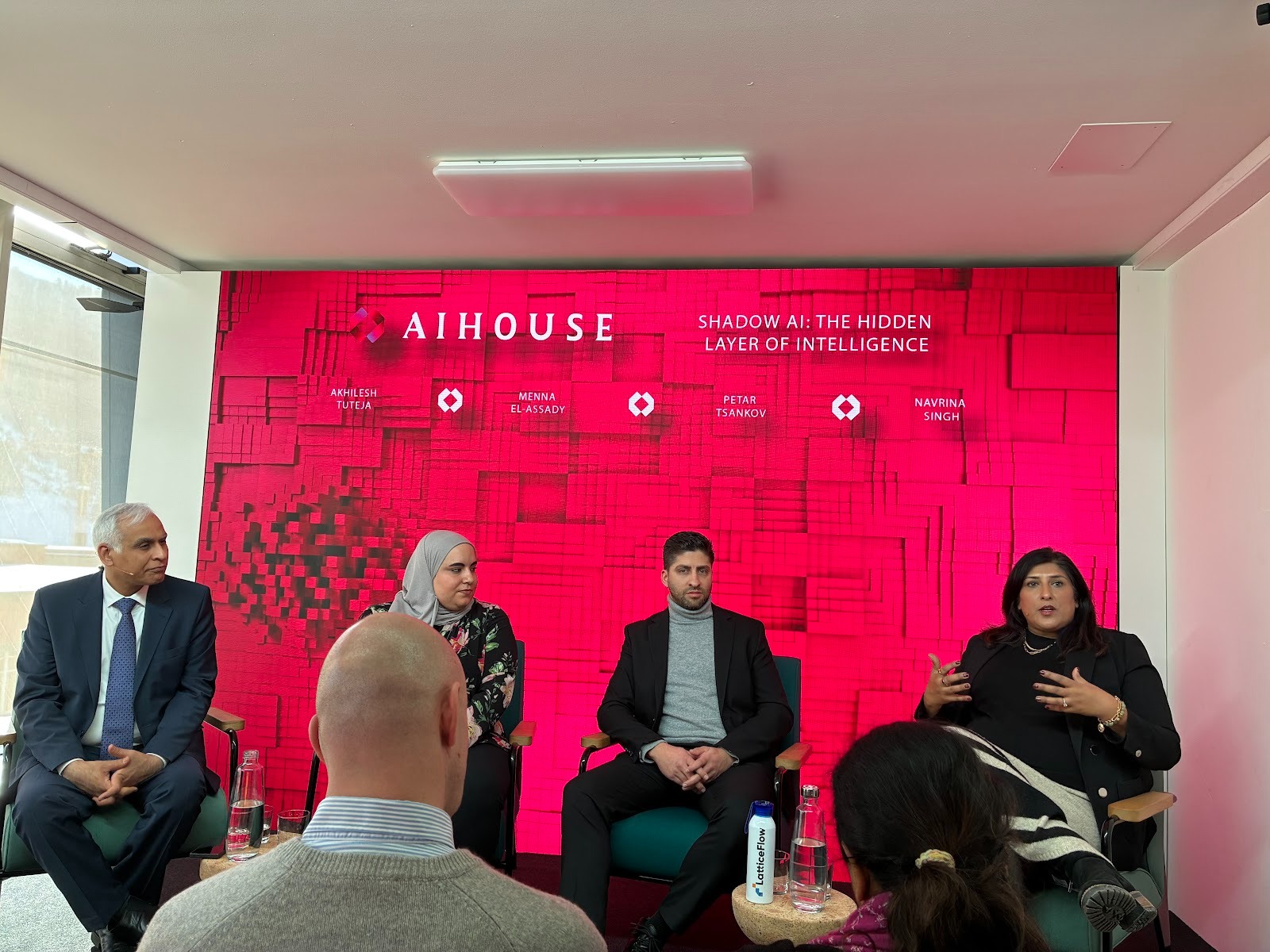
The most intriguing questions I heard during my panel at AI HOUSE weren't about model capabilities, but rather about managing hidden governance challenges, such as “Shadow AI” use.Shadow AI, the unauthorized or unmonitored deployment of AI tools within organizations, represents a critical governance mandate that transcends traditional IT security paradigms.
I shared with the audience that Shadow AI isn’t emerging because people are careless but because AI has become fast, cheap, and powerful enough for individuals to act independently. The urgency is the mismatch between how quickly AI is spreading and how slowly trust, governance, and accountability are evolving.
Trust depends on visibility and accountability. Shadow AI erodes both. When people don’t know where AI is being used, how decisions are made, or who is responsible, trust decays internally with employees, externally with customers, regulators, and the public. Shadow AI doesn’t just create isolated risks; it accelerates a systemic trust deficit that can stall adoption even of well-governed, beneficial AI.
To me it’s clear, bringing Shadow AI into the light starts with proactive leadership. Business leaders should employ organizational principles and the right technology to detect Shadow AI and promote its responsible use. But here's what's critical: literacy is the unlock.
Employees can't comply with policies they don't understand. Leaders can't govern technologies they can't explain. And society can't protect vulnerable populations, especially minors, from harmful AI interactions without broad-based AI literacy.
Action required: First, I would make AI use visible without making it punitive. That means creating safe ways for people to disclose how they’re using AI and why. Second, I’d invest in shared literacy, not just technical AI training, but decision-level understanding of impact, responsibility, and limits. For societal protection, especially of minors, we need to pair education with strong regulatory guardrails. Shadow use isn't just an enterprise problem. For the public, it's a child safety imperative.
3. Sovereign AI: A Multi-Dimensional Policy Challenge Requiring Technical Solutions and Trust
Throughout the week, Sovereign AI emerged as a dominant theme, but the conversation has matured significantly. Yes, nations want more independence across the AI stack: its infrastructure, compute, energy access to reduce dependencies and navigate export control realities. But there's a deeper layer that demands attention.
As Denise Wong from Singapore's IMDA put it: countries want to "preserve our way of life." This means building AI systems that reflect local cultures, languages, and values systems communities can actually trust.

The operational reality: Sovereignty exists on a spectrum. Embedding trust in systems needs to continue to be context-driven and reflect local realities. Data governance and compute environments should adapt with the sensitivity and deployment context of use cases with national security applications utilizing air-gapped, on-premise compute environments, while sensitive but public facing applications, such as those in healthcare, require secure data flows that enable highest quality and precision.
Action required: Organizations must architect for data sovereignty while maintaining the flexibility needed for AI systems to deliver value and align with global AI development practices. For AI governance, this means knowing which environments your data should live in and how to operationalize the right controls across hybrid systems.
4. One-Size-Fits-All AI Policy Won’t Work:
Context Is Queen
The clearest message from Davos: people want AI policy that understands operational complexity. A healthcare AI system faces different risks than a marketing recommendation engine. Financial services have different data sensitivities than retail.
Policy implications: Effective AI governance requires sector-specific frameworks that account for:
- Use case risk profiles varying across application domains
- Existing regulations in sectors with established governance (financial services, healthcare, critical infrastructure)
- Operational constraints specific to different industries
The "peanut butter approach", applying identical requirements across all AI deployments, generates compliance overhead without addressing actual risks. Context-aware AI policy must balance horizontal principles (transparency, accountability, fairness) with vertical, sector-specific implementation requirements and real measurement guidance.
Action required:To accelerate transformation with AI, especially for critical risk applications, regulatory approaches can bolster security. However, it is imperative for organizations to not just react to regulations, but to help shape frameworks that protect people while accelerating innovation. There is a need to translate sector-specific risks into practical, context-aware procedural and technical controls.

5. We Need More Stories About Winning with Impactful AI That You Can Trust
Here's something refreshing: people are hungry for positive AI narratives. Not hype, but genuine examples of AI creating organizational and societal value, improving healthcare outcomes, accelerating climate solutions, expanding educational access, augmenting human creativity and increasing productivity.
The AI discourse has been dominated by risk management (necessarily so to get AI right, someone has to think about all that can go wrong and mitigate it), but we're at an inflection point. The companies winning trust are those demonstrating measurable positive impact while managing risk thoughtfully.
Action Required: Effective governance frameworks should be risk-proportionate rather than uniformly restrictive, enabling high-benefit use cases in healthcare, climate adaptation, education, and more while maintaining stringent controls on high-risk applications. This requires:
- Regulatory sandboxes that enable controlled experimentation with beneficial AI applications
- Impact measurement frameworks that document societal benefits alongside risk metrics
In our engagements at the India House in Davos, India's vision for Global South AI leadership came into sharp focus: supporting impactful AI development through literacy initiatives, locally-relevant solutions, and business ecosystems that generate both community value and measurable economic growth.
Next month, we are proud to host AI leaders, policymakers, practitioners, entrepreneurs, and business leaders at our upcoming India AI Summit event discussing AI Governance for the Global South. Stay tuned for more information.

The Path Forward: Making AI Governance Operational
Davos 2026 made one thing abundantly clear:
Countries want to drive their AI transformation with systems they trust and represent their values.
Business leaders must cultivate trust with their stakeholders and invest in AI governance founded on measurable benchmarks and evaluations that represent desired outcomes.
This year's conversations confirmed it. The question isn't whether to govern AI. It's whether you have the systems, literacy, and tools to govern it effectively.
Three priorities emerge for 2026:
1. Build technical accountability architecture for AI systems, particularly multi-agent systems, so that the organizations can explain, control, or own its actions
2. Invest in AI literacy across organizational and societal levels as the foundation for effective AI governance
3. Develop context-specific AI governance frameworks that address actual operational risks rather than pursuing compliance with ill-fitting horizontal requirements
The organizations leading in 2026 aren't those with the most sophisticated models. They're the ones who can deploy AI systems that are trusted, accountable, and designed for the complex, context-specific realities of 2026 and beyond.
Let's build that secure and trusted future together.
Ready to operationalize AI governance in your organization? Contact Credo AI to learn how our enterprise platform turns measurable trust into your competitive advantage.
DISCLAIMER. The information we provide here is for informational purposes only and is not intended in any way to represent legal advice or a legal opinion that you can rely on. It is your sole responsibility to consult an attorney to resolve any legal issues related to this information.
.png)
.png)