

Human-Centered Design
Human-Centered Design (HCD) is an approach to designing products, systems, and services that prioritizes the needs, behaviors, and experiences of the people who use them. It focuses on understanding users deeply and creating solutions that are intuitive, effective, and meaningful.
In the context of AI systems, Human-Centered Design ensures that AI applications are built not just for performance, but for usability, trust, and real-world impact. It acts as a guiding framework to align AI deployment with human values.
Applying HCD principles is also critical for responsible AI adoption and governance, helping organizations balance innovation with user trust and ethical considerations.
.png)
Why Human-Centered Design Is Important
As AI adoption grows across industries, designing systems that people can understand and trust becomes critical. Human-Centered Design helps bridge the gap between advanced technology and real user needs.
Enhances User Experience
AI systems designed with users in mind are easier to understand, interact with, and rely on.
Improves AI Adoption
When solutions are intuitive and transparent, users are more likely to embrace AI applications in their workflows.
Reduces Risk in AI Deployment
Early user feedback helps identify usability issues, bias, and unintended consequences before large-scale rollout.
Supports Responsible AI
HCD ensures that ethical considerations like fairness, privacy, and inclusion are embedded into AI product development.
Common Use Cases of Human-Centered Design
Human-Centered Design plays a key role in shaping effective and trustworthy AI-driven solutions.
AI Applications
HCD ensures that tools like AI writing assistants, chatbots, and recommendation engines are user-friendly and aligned with real needs.
Virtual Assistants
Designing virtual assistants that understand user intent, communicate clearly, and provide meaningful support.
Predictive Analytics
Applying HCD to predictive analytics ensures insights are interpretable and actionable for decision-makers.
Enterprise AI Systems
Improving usability and trust in complex AI systems used for automation, decision support, and business intelligence.
Human-Centered Design in AI Product Development
In modern AI product development, HCD ensures that technology aligns with human expectations at every stage.
- During model selection, it helps choose appropriate machine learning models based on user needs.
- During design, it focuses on usability, transparency, and interaction.
- During deployment, it ensures smooth and ethical AI deployment.
- During iteration, it incorporates feedback to improve performance and experience.
By integrating HCD, organizations can build scalable and trustworthy AI solutions on a strong AI foundation.
Objectives of Human-Centered Design
Human-Centered Design aims to:
- Align AI systems with real human needs and behaviors.
- Improve usability and accessibility across AI applications.
- Support responsible and ethical AI deployment.
- Enhance trust and transparency in AI adoption.
- Enable effective and user-friendly AI product development.
How Human-Centered Design Works
Human-Centered Design follows an iterative, user-focused process:
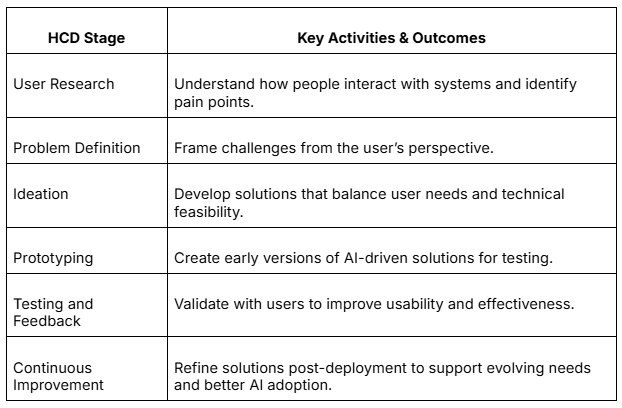
Why Human-Centered Design Matters in AI
As organizations increasingly rely on AI systems, designing them without considering human impact can lead to low adoption, bias, and poor user experience. Human-Centered Design ensures that AI remains aligned with human values while enabling innovation.
It plays a critical role in making AI not just powerful, but also practical, usable, and trustworthy across industries.
Summary
Human-Centered Design (HCD) is a user-focused approach to building products, systems, and AI applications around real human needs, behaviors, and experiences. It helps improve usability, trust, accessibility, and adoption by involving users throughout research, design, testing, and iteration. In AI, HCD supports responsible deployment by making systems more transparent, ethical, practical, and aligned with human expectations.
Frequently Asked Questions
Here you can find the most common questions.
What is Human-Centered Design in simple terms?
It is a design approach that focuses on creating solutions based on real user needs, ensuring they are easy to use and effective.
How does it apply to AI systems?
It ensures that AI systems are designed for usability, transparency, and trust, improving overall user experience and adoption.
Why is Human-Centered Design important for AI adoption?
It makes AI applications more intuitive and aligned with user expectations, increasing trust and encouraging wider adoption.