

Credo AI Policy Center
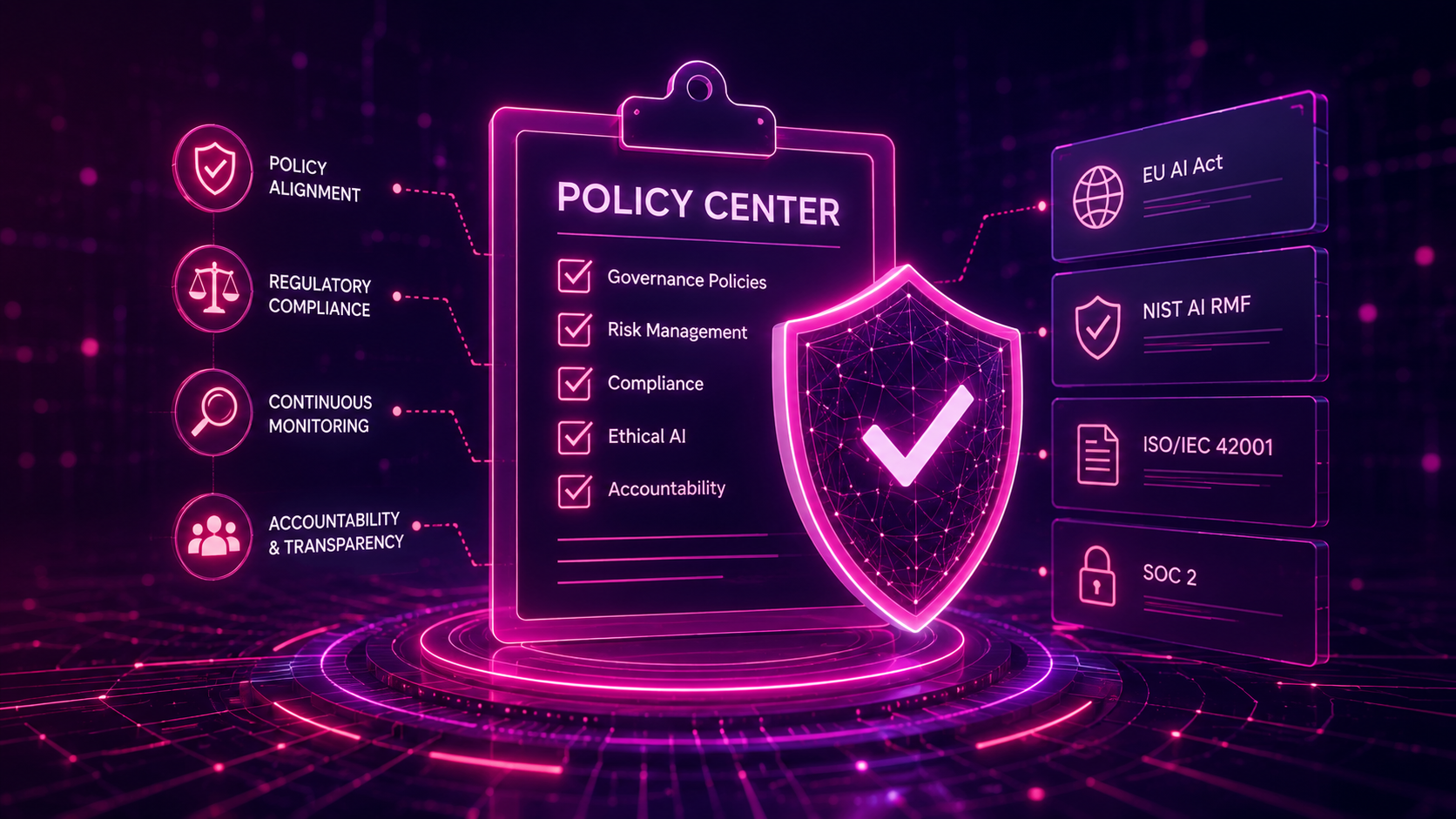
Credo AI Policy Center is in the process of defining and enforcing AI governance policies through a centralized system that ensures every AI model and application aligns with regulatory standards and internal requirements. It enables organizations to apply consistent rules across the AI lifecycle, maintaining control and accountability.
In simple terms, it acts as a layer of governance, translating complex policies into actionable controls within AI workflows, ensuring every outcome is reliable and compliant.
Why Credo AI Policy Center Is Important
AI adoption is accelerating, but governance processes remain fragmented, manual, and often disconnected from actual AI operations. This creates gaps between policy intent and real-world enforcement.
The Policy Center solves this by embedding governance directly into the AI lifecycle.
Converts policy into execution
Most organizations define policies but fail to operationalize them. The Policy Center bridges this gap by converting policies into enforceable controls within workflows.
Aligns with global regulations
Pre-built policy packs align with frameworks such as the EU AI Act, NIST AI RMF, ISO standards, and SOC 2, reducing the burden of manual mapping.
Enables continuous governance
Instead of point-in-time audits, policies are applied and monitored continuously as AI systems evolve.
Eliminates siloed governance
It centralizes policy management across teams, models, vendors, and applications, ensuring consistency across the enterprise.
Common Use Cases of Credo AI Policy Center
The Policy Center is designed for real enterprise governance scenarios where AI systems operate at scale.
AI Lifecycle Governance
Organizations apply policies at every stage of the AI lifecycle, from model registration and risk assessment to deployment and monitoring.
Regulatory Readiness and Audits
Enterprises use policy packs to automatically align with regulatory requirements and generate audit-ready documentation without manual effort.
Generative AI Guardrails
Policies define acceptable usage boundaries for generative AI systems, ensuring outputs remain aligned with ethical and business standards.
Real-World Examples of Credo AI Policy Center
Below are practical, enterprise-level examples aligned with how Credo AI is used in production environments.
1. Policy-driven AI onboarding
A company registers a new AI use case in the platform. The Policy Center automatically applies relevant policies based on use case, region, and risk category.
2. Automated compliance mapping
An enterprise maps internal policies to EU AI Act requirements using pre-built policy packs. This eliminates months of manual compliance work.
3. Continuous monitoring of AI systems
Policies are enforced during runtime, ensuring that AI systems remain compliant even as they evolve.
Objectives of Credo AI Policy Center
The Policy Center is built to move organizations from policy definition to policy execution.
- Operationalize AI governance
- Standardize governance across the enterprise
- Reduce compliance effort
- Improve transparency and accountability
- Scale governance with AI adoption
How Credo AI Policy Center Works
The Policy Center operates as part of a broader AI governance workflow.
- Policy Creation and Configuration: Organizations define internal policies or adopt pre-built policy packs aligned with global regulations.
- Contextual Mapping: Policies are mapped to AI systems based on factors such as use case, geography, risk level, and regulatory requirements.
- Enforcement in Workflows: Policies are embedded directly into AI processes such as model evaluation, deployment approvals, and monitoring.
- Continuous Monitoring: The system tracks compliance in real time, identifying deviations and triggering actions when necessary.
- Evidence and Reporting: Automated documentation and audit trails are generated for compliance reviews and stakeholder reporting.
Types of Policies in Credo AI Policy Center
The platform supports multiple policy categories based on enterprise needs.
Regulatory Policies
These policies align AI systems with global frameworks such as the EU AI Act, GDPR, and NIST AI RMF. They ensure that compliance requirements are embedded directly into AI workflows, reducing manual audit effort and improving regulatory readiness.
Risk-Based Policies
These define controls based on the risk classification of each AI system. Higher-risk models are subject to stricter validation, documentation, and monitoring requirements.
Ethical AI Policies
These ensure fairness, transparency, and accountability by enforcing responsible AI principles across development and deployment.
Operational Policies
These govern internal processes such as model validation, approval workflows, deployment checks, and continuous monitoring.
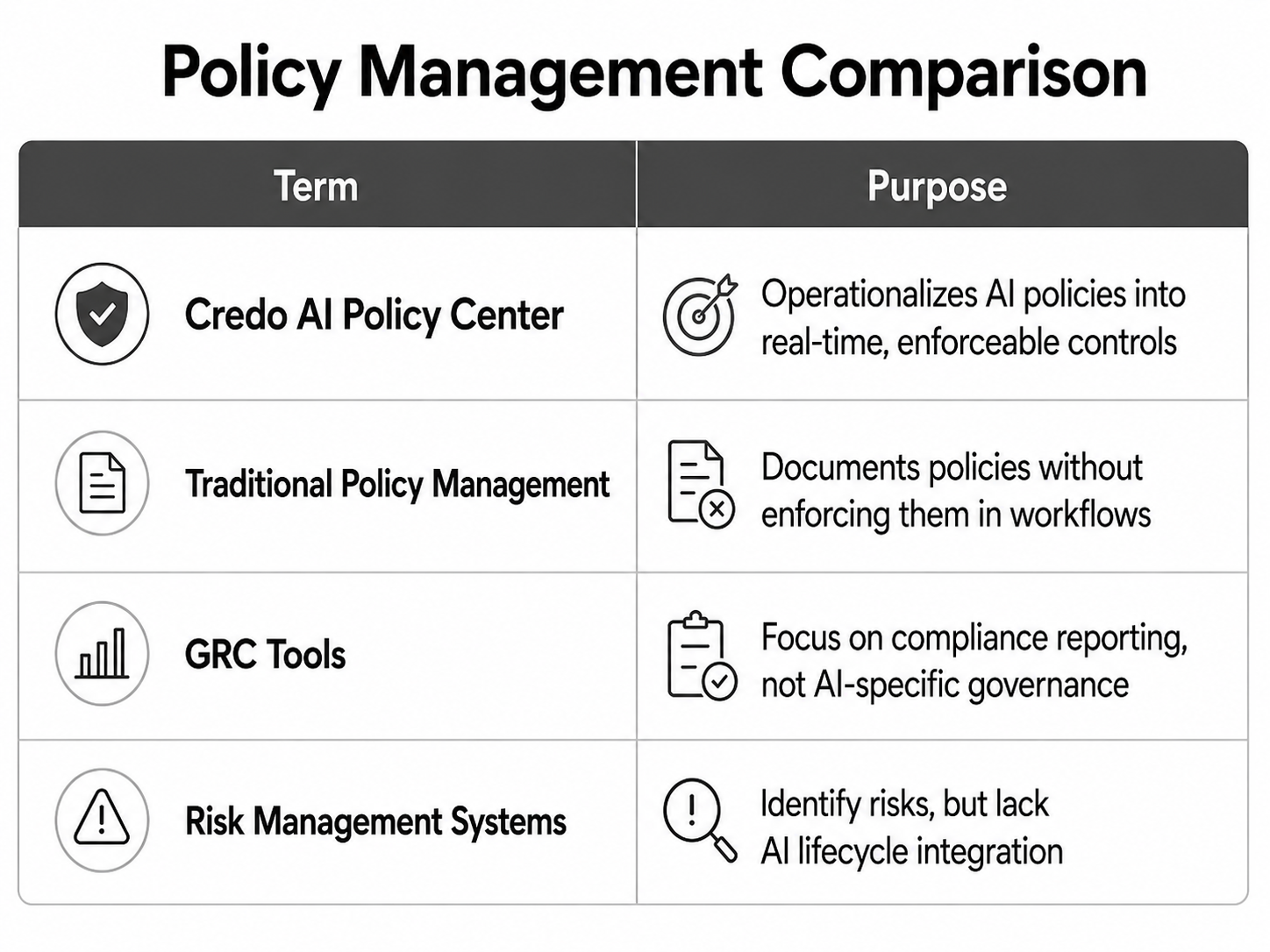
Credo AI Policy Center vs Traditional Policy Management
Summary
AI governance is no longer optional. As organizations deploy AI at scale, they need systems that can translate policy into action, continuously and at scale.
The Credo AI Policy Center plays a critical role in this shift by acting as the execution engine for AI governance, ensuring that every AI system operates within defined policies, regulatory requirements, and risk thresholds.
Without such a system, governance remains disconnected, reactive, and difficult to scale
Frequently Asked Questions
Here you can find the most common questions.
What is the Credo AI Policy Center in simple terms?
It is a system that converts AI policies into enforceable rules applied directly within AI workflows, ensuring consistent governance, compliance, and control across models, applications, and decision-making processes.
How is it different from traditional policy tools?
Traditional tools focus on documenting policies. The Policy Center embeds and enforces policies in real time within AI workflows, ensuring continuous compliance rather than relying on periodic reviews or manual checks.
Does it support regulatory compliance?
Yes. It includes pre-built policy packs aligned with major global regulations, enabling organizations to map requirements, enforce controls, and maintain audit-ready documentation without manual effort.
Why is it important for enterprises?
It enables scalable, consistent, and continuous AI governance, reducing risk, improving transparency, and ensuring that all AI systems align with regulatory requirements and internal policies.