

Standard
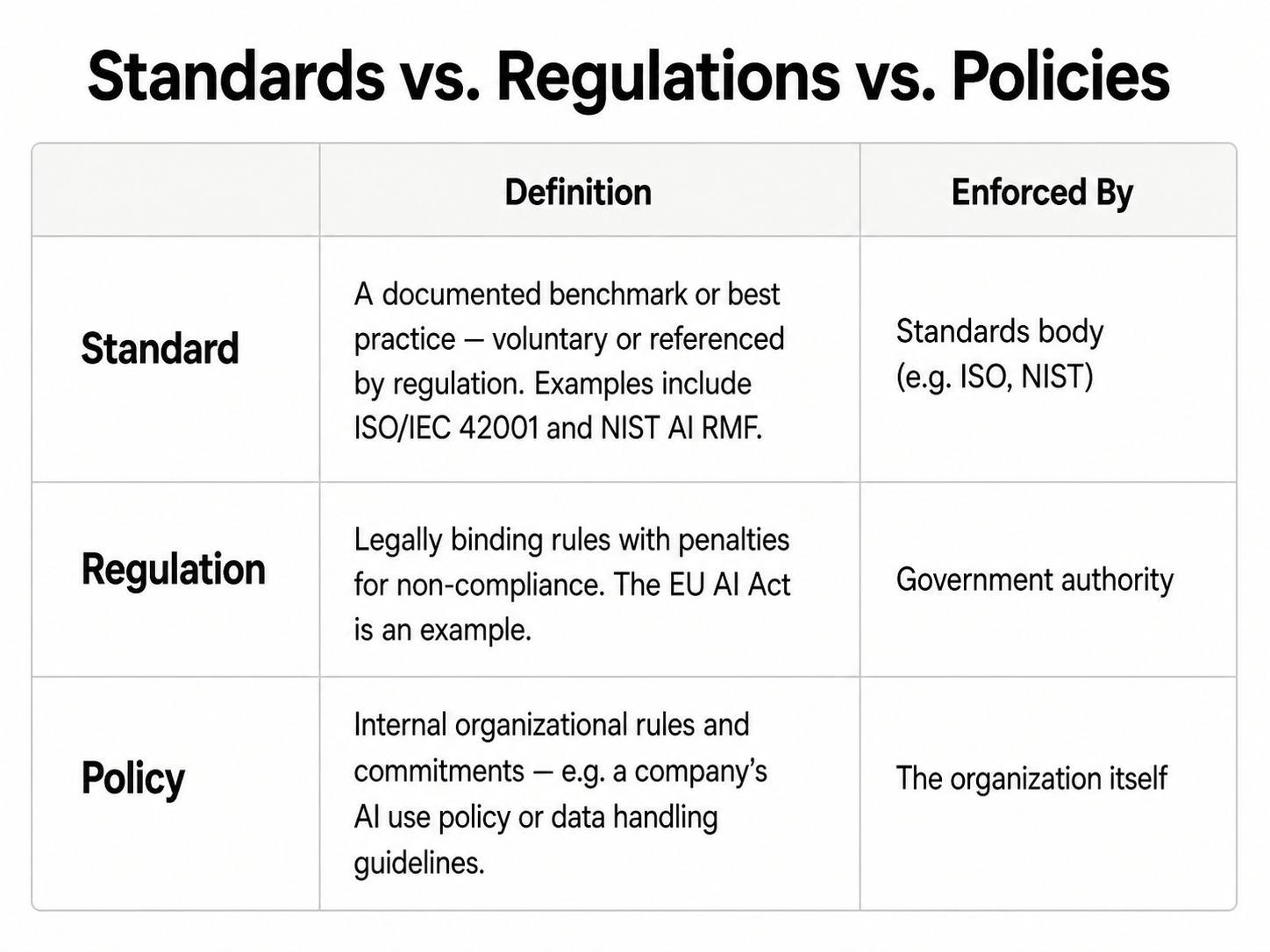
A standard is a documented set of criteria, guidelines, or requirements established to ensure consistency, quality, safety, and accountability in a product, process, or system. In AI governance, standards provide the benchmarks against which AI systems are built, evaluated, and managed. They are developed by recognized bodies such as ISO, government agencies, or industry coalitions, and can be voluntary or legally mandated depending on the jurisdiction.
See how standards-backed governance creates measurable business value.

What Do Standards Cover in AI?
AI governance standards are not one-size-fits-all. Depending on the standard, they typically address one or more of the following areas:
- Scope and applicability - the types of AI systems, industries, or use cases the standard applies to
- Requirements and criteria - what an organization must demonstrate in order to conform to the standard
- Risk classification - how AI systems are categorized based on their potential impact and risk level
- Documentation and evidence - the records and audit trails an organization must maintain
- Accountability structures - who within the organization is responsible for meeting standard requirements
- Conformity assessment - how compliance is validated, whether through internal review or third-party certification
Together, these components give organizations a clear and structured way to assess whether their AI systems meet accepted benchmarks of safety, fairness, and reliability.
Why Do AI Standards Matter?
When organizations deploy AI systems without a defined baseline, the results can be inconsistent, difficult to audit, and potentially harmful. Responsible AI standards address this by creating a shared reference point that everyone, developers, governance teams, auditors, and regulators, can work from.
Here is why standards matter in practice:
- Establish a common language: Standards align AI developers, legal teams, risk functions, and regulators around consistent definitions and expectations, reducing ambiguity across the board.
- Make accountability visible: When an organization conforms to a recognized standard, it has documented evidence of responsible AI practices that can be shared with regulators, customers, and partners.
- Reduce the risk of inconsistent outcomes: Without standards, similar AI systems in the same organization can be built and evaluated in entirely different ways, creating uneven risk exposure.
- Support regulatory readiness: Many regulations, including the EU AI Act, directly reference or rely on existing standards. Organizations that align with standards early are better positioned for compliance.
- Enable benchmarking: Standards give organizations a reliable way to assess their current practices against accepted norms, and to identify gaps before regulators or auditors do.
Without structured, responsible AI standards, organizations face inconsistent governance, increased regulatory exposure, and real difficulty demonstrating that their AI systems are trustworthy.
Key AI Standards and Regulatory Frameworks You Should Know
Several standards and frameworks are shaping how organizations approach AI governance today. Here are the most relevant ones:
- ISO/IEC 42001 is the world's first internationally recognized ISO 42001 standard for AI management systems, developed and maintained by ISO/IEC JTC 1/SC 42, the joint technical committee dedicated to AI standardization. It is certifiable, meaning organizations can undergo a third-party audit to formally demonstrate conformity.
- NIST AI RMF is a widely adopted NIST AI RMF standard published by the U.S. National Institute of Standards and Technology. It helps organizations manage AI-related risks across four core functions: Govern, Map, Measure, and Manage. It is voluntary but widely referenced across industries and jurisdictions.
- EU AI Act is not a standard itself, but it references recognized standards as part of its compliance requirement, particularly for high-risk AI systems. For organizations operating in the EU, aligning with relevant standards is effectively mandatory.
- ISO/IEC 27001 is an information security standard that many organizations apply as a foundational layer beneath their AI governance programs, especially where AI systems handle sensitive data.
How Organizations Use Standards in AI Governance
AI governance standards are not a one-time compliance exercise. They serve as a continuous reference across the AI lifecycle - from system design through to ongoing monitoring.
Here is where organizations typically apply them:
- Design and development - standards define which controls and documentation requirements need to be in place before a system goes live, not after.
- Vendor procurement - when a vendor demonstrates conformity with a recognized standard, it gives organizations a structured basis to evaluate trustworthiness.
- Regulatory compliance - standard conformity creates a documented foundation that organizations can point to under frameworks like the EU AI Act or U.S. state-level AI regulations.
- Stakeholder reporting - standards give leadership a credible, externally recognized framework to communicate how AI risk is being managed.
- Continuous monitoring - standards require ongoing oversight as AI systems and regulations evolve - not a set-and-forget approach.
How to Apply a Standard, Step by Step
- Identify applicable standards - based on your industry, jurisdiction, and AI risk level. Most organizations start with either the ISO 42001 standard or the NIST AI RMF standard.
- Conduct a gap assessment - compare current practices against the standard's requirements to identify what needs work.
- Implement required controls - embed documentation, accountability structures, and risk assessments into existing workflows.
- Conformity assessment - validate implementation internally or via a third-party auditor. For ISO/IEC 42001, this is a formal certification step.
- Monitor and maintain - standards, systems, and regulations all evolve. Ongoing monitoring is required, not optional.
- Keep audit-ready documentation - maintain clear records at every stage. These are what regulators and auditors will ask for.
For a broader context on where standards fit within an AI governance program, read What Is AI Governance? (And What It Isn't).
Best Practices for Working With AI Governance Standards
- Start with what applies to you - your industry, jurisdiction, and AI risk level determine which standard to prioritize first.
- Conformity is a floor, not a ceiling - minimum requirements are the starting point. Strong governance programs go further.
- Bring in the right stakeholders early - legal, technical, risk, and business teams all need to be involved, not just compliance.
- Document decisions, not just outcomes - regulators want to understand how governance choices were made, not just what they resulted in.
- Build for adaptability - standards, regulations, and AI systems all change. Governance processes need to keep pace.
- Use purpose-built tooling - manual workflows do not scale. The Credo AI Governance Platform helps organizations implement and maintain standard conformity continuously.
Summary
Responsible AI standards like ISO/IEC 42001 and NIST AI RMF give organisations a structured, verifiable foundation for building and managing AI systems that regulators, customers, and partners can trust. AI governance standards are not about bureaucracy; they are about proving, consistently and credibly, that your AI meets an accepted bar for safety and accountability.
Frequently Asked Questions
Here you can find the most common questions.
Are AI standards legally required?
AI standards are usually voluntary. However, laws, contracts, regulators, or procurement rules may require them. Regulations like the EU AI Act can reference recognized standards to help organizations demonstrate compliance.
What is the difference between a framework and a standard?
A framework provides flexible guidance, while a standard defines specific requirements or benchmarks. Frameworks help structure decisions; standards are often used for audits, conformity checks, or certification.
What is ISO 9001 vs 14001 vs 45001 vs 27001?
These are ISO management system standards. ISO 9001 covers quality, ISO 14001 covers environment, ISO 45001 covers workplace health and safety, and ISO/IEC 27001 covers information security.